
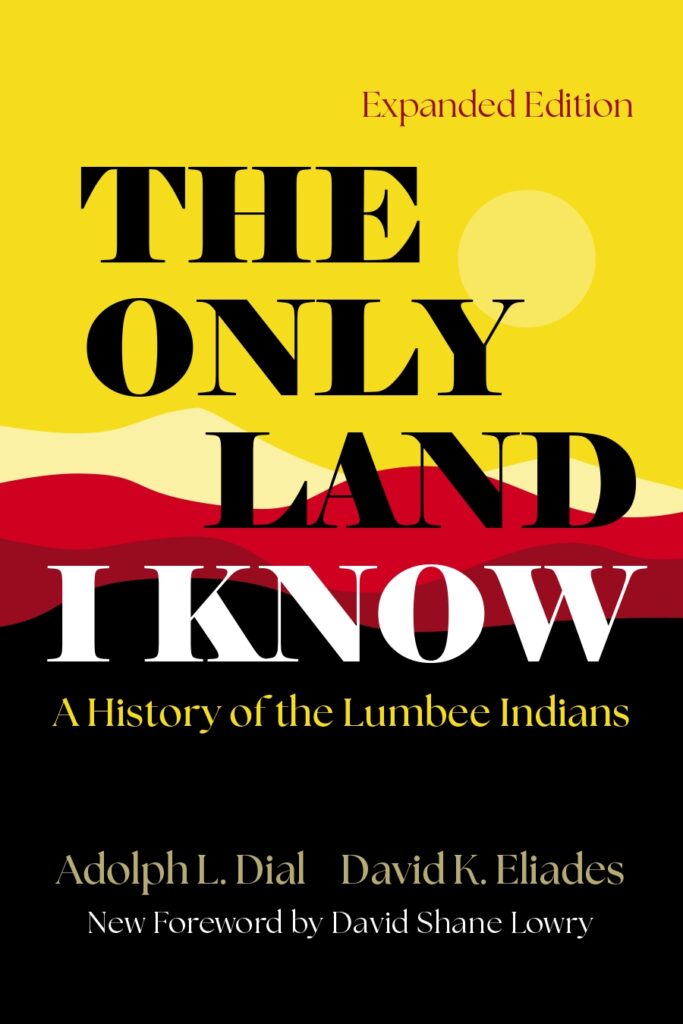
As we celebrate Indigenous Peoples Day, we spoke with David Lowry, a member of the Lumbee Tribe and the forward writer of the upcoming expanded edition of The Only Land I Know: A History of the Lumbee Indians by Adolph Dial and David Eliades. Lowry’s new forward speaks to the Lumbee’s recent federal recognition as well as featuring a discussion on connection to land and geography missing from the original printing. Below is our discussion in preparation for the spring release of the book.
Tell me about how you first encountered The Only Land I Know. Were there elements of the text in particular that spoke to you as a scholar?
I first read The Only Land I Know while I was in college at MIT. I used it as an alternative book, one that I could use in my research, in a class on Native American policy at Harvard University in the Kennedy School of Government.
When I first read TOLIK, I read it politically. That is, I wasn’t trying to read it to get information. Rather, I wanted to know how Dial and Eliades positioned themselves within certain stories about the Lumbee community that I already knew a lot about. Dial was a fantastic storyteller, and his stories are as compelling now, in 2026, as they were back in the 1970s. Nevertheless, I read them with a sense of “Why did Dial and Eliades choose to tell that story, that way?!”
Lumbee people do this in everyday life. That is, we try to figure out what “angle” people are taking when they present information. Yes, all humans do this figuring. But Lumbee people do it best! We are good listeners…really good listeners. It makes us great attorneys, healthcare providers, and professors. Within those contexts, sitting down with the wonderful collection of Lumbee stories that define TOLIK was a great experience.
What was the experience of revisiting and contributing to the volume like for you?
Many scholars use the writings of Vine Deloria Jr. to help them create conversations with students about what American Indian peoples experience. They look at his famous books, many of which were written about the same time as TOLIK, as necessary to Native American and Indigenous Studies. But I think TOLIK is just as important as Custer Died for your Sins and other books written by Deloria. Perhaps more important! As such, I am happy to shine a light back onto Dial and Eliades – and the work that they undertook, over many years, to tell the Lumbee story – as a way to shake up or, open up the discipline of Native American and Indigenous Studies. Do I agree with all of what they write? No, and I hope that my contribution to the new edition of TOLIK encourages young scholars to write their own stories of their tribal nations as we attempt to broaden Native American and Indigenous Studies so that it becomes the core discipline within liberal arts, science and engineering disciplinary fields within the United States of America.
What do you hope people take away from reading The Only Land I Know or what do you think the public should know about the Lumbee story in particular?
Want me to be honest? America is a huge project of brain washing. Americans, across the board, have been taught to not see American Indian peoples and nations because doing so opens up conversations about the fact that America, as stolen lands, ought to be returned. Why aren’t American citizens and journalists asking for there to be American Indian people on the Supreme Court of the United States? Indeed, that is the power and the sadness of TOLIK. Yes, Dial and Eliades showcase elements of Lumbee pride, e.g., the routing of the KKK in 1958. However, Dial and Eliades only focus on particular stories that place Lumbee people in particular places and, in my mind, limit the power and influence of Lumbee community. That is why I wrote the “Foreword” to TOLIK in the fashion that I did. As I read TOLIK, for probably the 5th time, I saw moments where Dial and Eliades attempt to fit Lumbee life into a box to be easily consumed and understood. In reality, the Lumbee story is quite large and complicated. Lumbee people have wide shoulders –metaphorically and, sometimes, physically. We are quite brilliant. We are quite talented. And I feel like we Lumbee people are often afraid to discuss how that brilliance and talent continue to be purposely suppressed within institutions and governments that we are loyal to.
One of the things your foreword touched on is how much relocation and diaspora have shifted this idea of “land” for the Lumbee beyond one specific, physical space. How do you see this issue today? How has the idea of “land” shifted for the Lumbee as many have relocated and diaspora communities have emerged?
This part of my argument in the “Foreword” to TOLIK is a slight nod to my book Lumbee Pipelines (Nebraska, 2025). In that book, I make a substantial argument about the need to pull Native America away from having to be locatable and attached to very specific places and spaces. For example, I tell the story of how I found out, around 2008 or 2009, that Navajo people essentially performed as (acted as) Hualapai people on the Hualapai reservation because, at the end of the day, tourists didn’t know the difference. American Indian peoples, more generally, have committed ourselves to being mobile. We understand the fact that movement is perhaps the most significant aspect of being human. So, as I thought about writing about the impact of TOLIK, it became apparent that Dial and Eliades were under some pressure to not value Indigenous movement within their overarching attempt to shine a light on the importance of Lumbee people as a tribal nation in need of full, un-stymied recognition by the U.S. Federal Government and everyone else.
On that note, in Lumbee Pipelines, I talk a lot about how Lumbee people have experienced theft of land. One of the stories that I tell is of Lumbee farmers who, in 2020, were fighting Duke Energy in their (Duke Energy’s) attempts to annex Lumbee land for gas pipelines. As we were talking, Lumbee farmers described how they were first given a chance to buy their land back from White families in the early 1990s. So, over about 30 years, Lumbee farmers went from buying their land back from white families, who, for centuries, had more rights to land than Indian families, to fighting energy corporations, who, now, have more rights to land than Indian families.
Also, Lumbee land, in Robeson County, North Carolina, was the site of a famous UFO sighting in 1975. As TOLIK was rolling onto library and university shelves – as Lumbee people were beginning to see academic discourse about what it means to define Indigenous claims to land and space – Lumbee people were already thinking about worlds well beyond human, earthly conceptualizations of place, space and land. On that note, many Lumbee people have relationships with Jesus Christ. As such, they think about heaven, about the afterlife, as a transition to “streets of gold” and other, celestial geographies. In the end, the pressures that colonialisms have placed on American Indians to stick ourselves in certain earthly “lands” must make you, the reader, pause to consider why we think about the world within certain limits.
Since the book was originally published, the Lumbee have received federal recognition. Can you speak to what that recognition means for the tribe today culturally and if it has changed the culture in a measurable way in the year since?
Now that Lumbee people have been fully recognized by the Federal Government, we Lumbee citizens have a big conversation ahead of us: Are we allowed to change and transition without falling into the traps of placed-based nationalism? The pressures are real and raw. The Lumbee Tribe, in this moment, is in the midst of investigating a 6+ million dollar “land flip” in which leaders within the Lumbee Tribe’s government used money from our tribal purse to pay someone at least 3 million dollars – we just don’t know who, or for what!
Also, Lumbee land has long been a “destination” for Lumbee people. But now, post recognition, there are pressures to make it a tourist destination. Lumbee land has long been a corporate destination, used and abused by corporations like Dupont and Chemours. Now, I wonder if federal recognition will, seemingly overnight, make it unacceptable or taboo for Lumbee leaders to allow our lands to be poisoned. Time will tell.