

In honor of Arab American Heritage Month, we discussed the new book, Muslims in Milwaukee: Placemaking, Belonging, and Activism, with the book’s authors, Anna Mansson McGinty, Caroline Seymour-Jorn, and Kristin M. Sziarto. The book examines contemporary Milwaukee, a highly segregated midwestern city with a growing Muslim population. Unlike areas such as Detroit and Los Angeles, with larger Muslim populations, Milwaukee offers a fascinating case in how a community grows and changes in response to its residents.
Tell us about the Muslim communities in Milwaukee. How are they different than Muslim communities in bigger cities such as Detroit or Chicago?
First, just as Milwaukee is a smaller city in a midsized metro area of over 1.5 million people, the Muslim communities are smaller. Nevertheless, some of Milwaukee’s Muslim communities have been established for over four generations because of Arab immigration in the 1920s and then again in the 1940s. The 1950s and 1960s brought Muslims from Pakistan and India. African American communities also appeared with part of the Great Migration reaching Milwaukee in the 1920s. By the 1960s Black Muslims had established a temple in Milwaukee. These communities have grown and established their leadership in religious and community organizations. More recently arrived Muslims include Rohingya refugees from Myanmar, and from Afghanistan.
To summarize how Muslim communities in Milwaukee are different: First, they are smaller in terms of absolute numbers of people. They are also a smaller percentage, with Muslims being about 1% of Milwaukee’s total population compared with an estimated 3% to 4% in Detroit and Chicago. Also, each of these three metro areas has its own unique combination of ethnic groups, with Milwaukee having very strong Arab/Middle Eastern, South Asian, and African American presence and leadership, both historically and today. Albeit small in numbers, the Milwaukee Muslim communities are incredibly diverse, nationally, ethnically, racially and linguistically. For example, in our household survey we found that at least eighteen language other than English were spoken among Muslims in Milwaukee.
How have Muslims shaped the city of Milwaukee, both historically and today?
The Muslim community spaces we see today are the product of decades of Muslim presence and community-building in Milwaukee. Among the most obvious impacts on the city are the changes to the built environment. There are nine mosques, two Muslim schools, several community centers, and multiple food shops, restaurants, and coffee shops run by Muslims that serve the larger community.
Decades ago, the leadership of the first mosque decided to encourage Muslims to settle near the mosque on the south side. The south side of Milwaukee has historically been the “immigrant gateway” of the city; it used to be largely Polish, but today it has many Latinx residents and businesses, and many Arab residents and businesses, as well as South Asian, Turkish, and people of other backgrounds who are likely to be Muslim.
This concentration on the south side, combined with networks of community organizations, enables fast responses to events affecting the community. A recent example of this was the lightning response to the ICE detention of Salah Sarsour, the president of the Islamic Society of Milwaukee on March 30, 2026. Within two days, the ISM held a press conference attended by hundreds of supporters. Within a week the news had spread to local, state, national, and international sources, and had statements of support from multiple elected officials, clergy of other faith traditions, and community and labor groups.
In your research, did you find a younger generation of Muslims engaging and contributing to the Milwaukee community in a different way than previous generations?
We don’t really explore differences between younger and older generations; generational differences exist within all demographics, and we must be careful not to homogenize generations, overlooking the complexities within them. We found that young Muslims have taken advantage of the structures and community building completed by previous generations in that they network within these organizations, like the group Ma’ruf: Strengthening Faith Through Action. Ma’ruf, which was founded in 2008 by a first generation South Asian American, is a non-profit organization primarily geared towards Muslim youth with a Youth Center and programs that focus on the most disenfranchised.
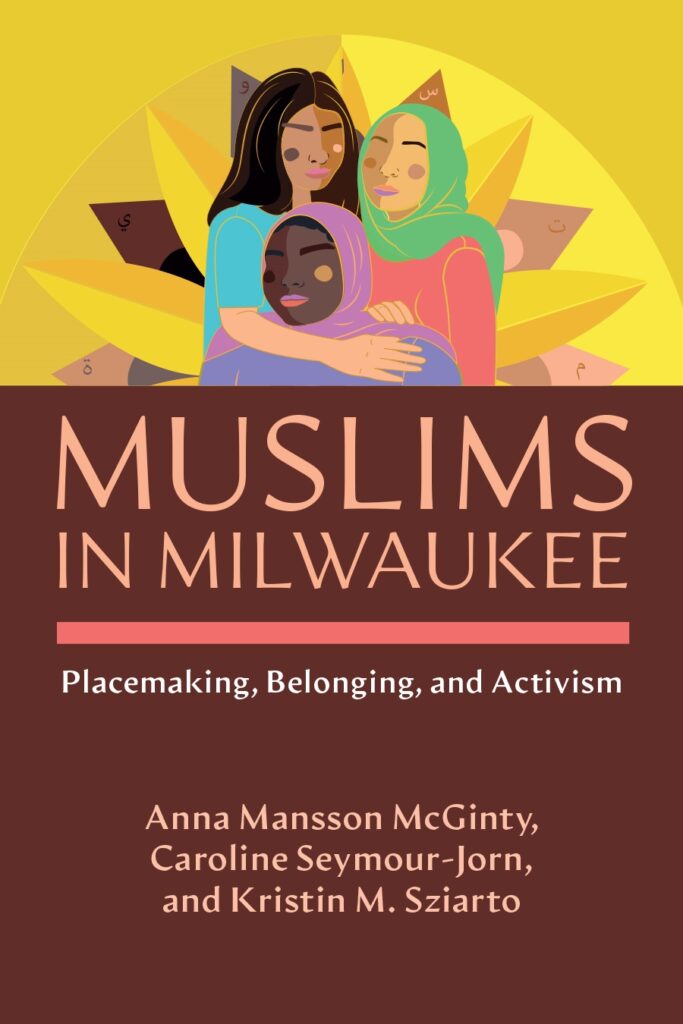
We are also interested in young artists because they continue the work of developing new spaces for Muslims in Milwaukee, like doing public art, establishing themselves within existing artistic groups, and contributing their voices to debates and concerns within Milwaukee, including on issues of racism and discrimination and international issues such as the genocide in Gaza. One such art collective is Fanana Banana (fanana is the Arabic word for “female artist”), which was founded by two young Palestinian American Muslim women in 2019 with the goal of creating material and digital art spaces for Muslim, Arab, and underserved artists in the Greater Milwaukee area. They have organized a few murals in different spaces across the city of Milwaukee, including the one in the Milwaukee County Courthouse, featured on the cover of the book. These young artists also contribute to challenging discussions; for example, Liala Amin’s work explores issues of the female body in bold canvases.
What inspired you to write Muslims in Milwaukee and what do you hope readers take away from it?
The Muslim Milwaukee Project started back in 2011 when a couple of Muslim leaders approached our university with the intention of conducting a demographic survey in partnership with scholars. This is when we started collaborating with the Muslim communities on two surveys—a household survey and an individual survey. Anna and Caroline had already worked with Muslim community members on a Combating Islamophobia initiative. Kristin had studied religion-labor alliances and was interested in religious community building. So, we were all interested in the Muslim communities here, but the inspiration for our research together was a few of the Muslim leaders themselves. We were also eager to learn more about the Muslim students we had in our classes and their everyday lives.
After a decade of ethnographic work and community collaboration, we had very rich ethnographic material that deserved to be presented in the larger format of a book, rather than journal articles, to reach a broader audience. In the book, we have aspired to give justice to the diversity and complexity of a small but growing community and demonstrate how Muslims have made Milwaukee their home through everyday placemaking. We hope the book provides a nuanced portrayal of a religious minority that has contributed significantly to the city in the face of War-on-Terror culture and anti-Muslim racism.