
"Masterfully takes us on a journey from the late Ottoman Balkans to the Balkans of the nation-states. Focusing on Rusçuk—one of the most vibrant and cosmopolitan cities of the Danubian Balkans—Çelik shows how Ottoman imperial reform, a short-lived period of Russian rule, and the Bulgarian nation-state unfolded on the ground. Joining a growing body of new scholarship, Çelik foregrounds the transition between Ottoman and national regimes in all its complexity—its continuities and ruptures."—Ali Yaycıoğlu, author of Partners of the Empire
"Çelik’s stimulating book draws on multilingual archival research to explore this urban center on the Danube as the vanguard of Ottoman reform."—Uğur Zekeriya Peçe, author of Island and Empire: How Civil War in Crete Mobilized the Ottoman World
"An important work for its innovative perspective, cross-disciplinary approach, and for introducing fresh archival material in several languages."—Leyla Amzi-Erdogdular, author of The Afterlife of Ottoman Europe: Muslims in Habsburg Bosnia Herzegovina
Description
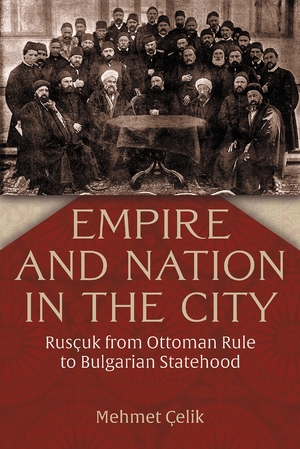
In the age of nationalism, the Ottoman Empire charted a different course, one promoting Ottomanism as a unifying identity through ambitious modernizing reforms. With the establishment of the Danube Province in 1864, Rusçuk (present-day Bulgaria) became its capital and a test case in a contested provincial landscape. What followed were a series of swift political transitions from a “modernized” Ottoman administration to a Russian provisional government and finally to a Bulgarian nation-state.
In Empire and Nation in the City, Mehmet Çelik argues that Bulgarian nationalism was not a uniform ideology but a flexible one engaging multiple loyalties—Bulgarian and Ottoman among them. He shows how political integration, economic growth, and surveillance constrained nationalist activity while compelling many non-Muslims to invest in the empire’s longevity. Yet pragmatism and social class proved as powerful as nationalism and religion, leaving many individuals indifferent to the later concerns. Rather than assess Ottoman rule and Bulgarian nationhood as separate periods, Çelik reveals the continuity of Ottoman reforms within a burgeoning Bulgarian nation.
Table of Contents
Introduction
1. Reforming Criminal JusticePolice, Courts, and Prisons, 1839–1864
2. Provincial Administration Reforms of 1864 and Pragmatic Governance
3. Economic Modernization in the Tanzimat
4. Bulgarian Nationalism and “Russian Liberation”
5. The Russian Provisional Government, February 8, 1878–April 28, 1879
6. Rusçuk Under Bulgarian Rule, 1879–1885
Conclusion
Bibliography
Index
About the Author
Mehmet Çelik is a senior academic advisor and lecturer in the Department of History at the University of Texas at Austin. His research focuses on Ottoman, Balkan, and Turkish history.
Series: Modern Intellectual and Political History of the Middle East
6 x 9, 352 pages, 11 black and white illustrations, 4 maps
May 2026