
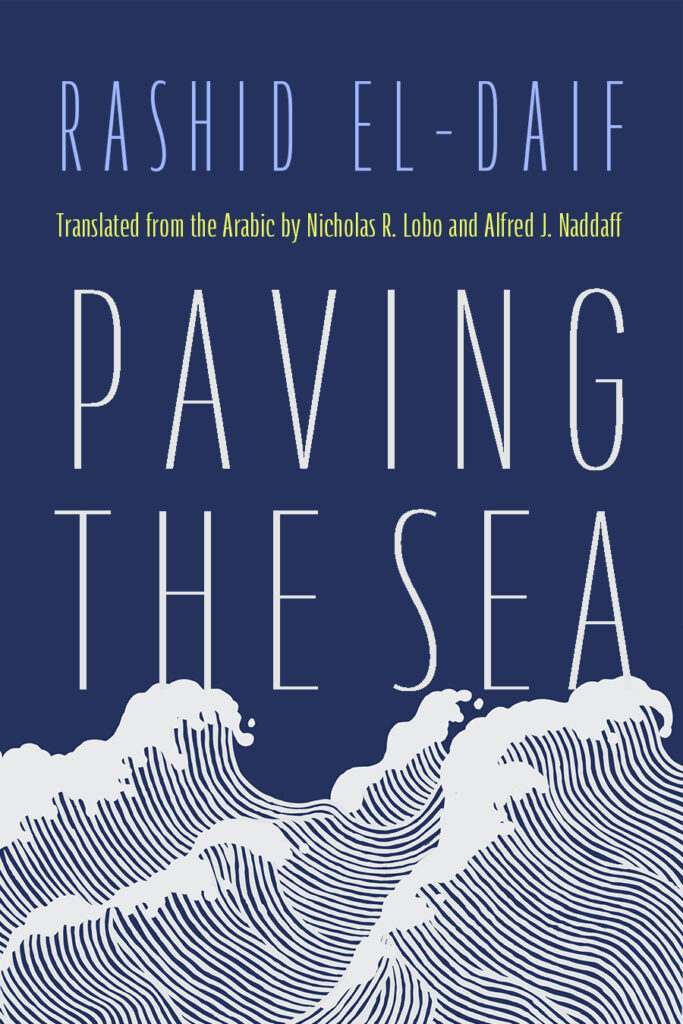
As part of National Translation Month, we sat down with the translators of the upcoming Paving the Sea, to talk about their work translating this beloved modern novel, their history, and what to expect from the book.
What drew you to Paving the Sea and made you want to translate it?
Nicholas R. Lobo: I was fortunate to have been able to spend around a year and a half in Lebanon as an undergraduate, between semesters and summers abroad. Life in Beirut and my studies at what was known as the Syrian Protestant College during the novel’s timeline (today the American University of Beirut) instilled in me a great fondness for the country’s rich culture and provided firsthand insight into its complex (and fascinating) history.
Alfred J. Naddaf: The first time I stumbled upon it; I stayed up all night reading it. It’s a Lebanese migration saga set around the time when my great-grandparents sailed off from Mount Lebanon to America, brimming with biting sarcasm and historical insights.
What creative person has influenced you and your work?
NL: I owe a great debt of gratitude to the late Syrian-Palestinian screenwriter and novelist Hasan Sami Yusuf (1945–2024), who wrote the novel that was the basis of my first literary translation project, Threshold of Pain. Through the countless hours I spent reviewing every page of the book, Yusuf’s sharp wit, intricate stream-of-consciousness narration, and skillful blending of literary and colloquial registers not only influenced my approach to translation but deeply shaped my prose in Arabic as well as English.
AN: Most recently, Suzy Hansen; I just devoured her two books. Both stories, blending historical research with delicious journalistic prose, helped me understand so much of what I couldn’t put to words around my own positionally as an American living abroad in general in a “post-American world” and as someone trying to understand the kaleidoscopic city of 2026 Istanbul in particular.
How did you get started as a literary translator?
NL: When I returned to the U.S. after spending two semesters at AUB, I was invited to take part in translating a novel from Arabic to English with my major advisor and mentor, Dr. Rebecca Joubin. Just two years prior, Dr. Joubin had introduced me and a dozen other beginners to the Arabic language, constantly reminding us that learning Arabic need not be a stressful or daunting task. I was thrilled to accept the offer and soon developed a great love for translation as both an intricate technical process and a unique mode of literary artistry. This abiding love would eventually lead me to find work as an academic translator at a Doha-based think tank, all the while continuing with literary pursuits such as Paving the Sea.
AN: All thanks are due to my incredible mentor and first Arabic teacher, Dr. Rebecca Joubin, a gifted scholar and literary translator from Arabic and Persian into English. She taught me that translation is an art and that translators are the most intimate readers of a text, what Gaytrapi Spivak theorized a while ago.
Tell us 3 things about the novel that will resonate with readers
NL: Most Americans know about the influx of immigration through Ellis Island in the late 1800s and early 1900s. A great many challenges awaited new arrivals from Europe, who crossed the ocean in pursuit of opportunity or to escape persecution. Far less common, however, are the tales of non-European migrants, such as “Turks” – many of whom, including the novel’s protagonist Fares Hashem, were not actually Turkish but simply hailed from parts of the Ottoman Empire.
More intriguing still is the fact that Fares decides to migrate not simply to send money to family back home, but to complete his medical training (which he started in Beirut) and achieve his dream of becoming a physician. En route to this objective, he finds himself in need of money and so takes up work as a peddler as did many others who emigrated from Greater Syria. There was a universality to the vicissitudes and joys of migration in that era, but only those from the Levant like Fares could claim – before audiences of eager parishioners, for instance – to hail from the Holy Land!
Readers familiar with New York will have heard of Manhattan’s many long-standing ethnic enclaves, such as Chinatown or Little Italy – but what about Little Syria? Though the neighborhood no longer exists, the contributions of immigrants from Ottoman Syria to the United States live on both in the lively human tapestry of New York City, as well as in unexpected places such as the ranks of the volunteer troops who fought in the Spanish American War.
AN: Americans have been involved in modern Middle East politics through foreign interventions for as long as most of us can remember. But do you know the story of the American missionaries from Boston trying to save “Syrian” souls in the 1800s?
You might also have wondered before, what are the antecedents of the modern crisis of Lebanon today? This novel also tells us to look further back, to the messy origins of modernity, to the American Protestants, Ottoman superstructure and native dreamers.
The following details found in the novel might not resonate but they hope to provoke. Have you ever read about the theft of corpses for anatomy lessons at the American University of Beirut? About the lives of Arab sex workers in the nineteenth century? About the racism faced by an immigrant of average height, with dark hair, olive skin, and black eyes navigating waspy New England while falling in love with a pastor’s daughter”?