

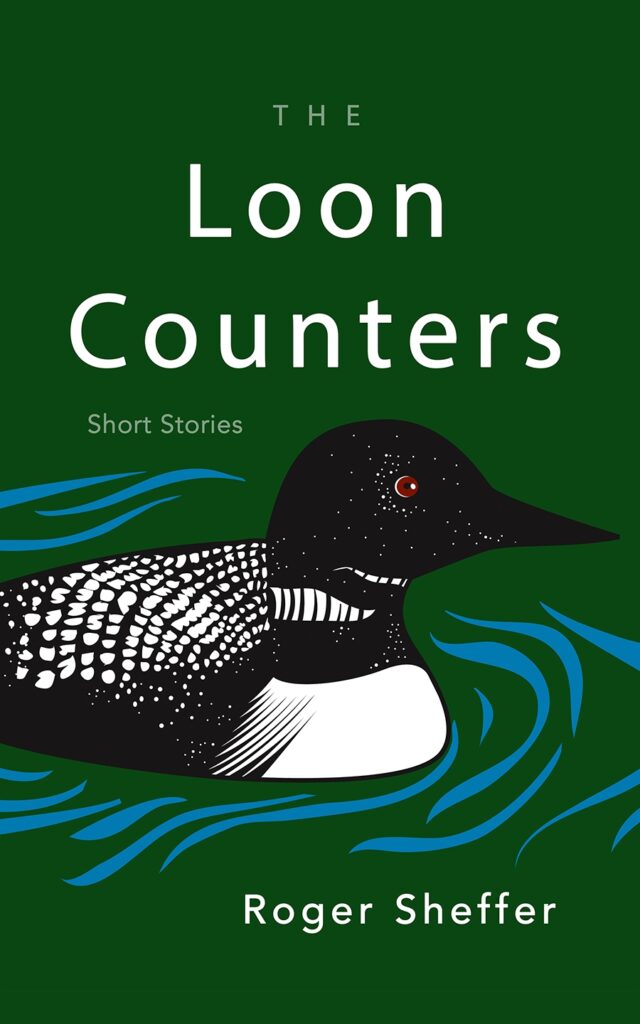
September’s Read New York Challenge title is Roger Sheffer’s The Loon Counters, a collection of short stories examining the relationships between people and nature in a pair of imaginary Adirondack towns. To celebrate the occasion and take a look back at the title, we sat down for an interview with author Roger Sheffer to ask some questions about his process, how he came to define his Adirondacks, and maintaining tone across stories.
Tell me a little about the history of The Loon Counters. What sparked the idea for the book and how did the manuscript and text evolve?
The book, when first submitted to Syracuse University Press, was a collection of thematically-related stories, mostly set in the same fictional Adirondack location, but with no continuity among the stories. Some of the stories even had the same name for different protagonists. Natalia Singer, who was a peer reviewer for the collection, suggested that I re-write “Counting Loons” as the core story for what would be a “linked collection,” featuring many of the characters who already appeared in the other stories. It was such a good idea that I added another specifically loon-counting story, set a few years later—“Recounting”—in which changes among the various characters were indicated during the conversation among the loon counters.

The Loon Counters takes place in an imaginary Adirondack county but is filled with lived-in details and observed examples of life and work in the area. What was your research process like for the book?
I didn’t really need to do any research, unless an ordinary routine of hiking and boating and being in the Adirondacks could be called “research.” And having a lot of relatives who lived and worked in the Adirondacks. I did look up some historical dates: for “Torch,” I wanted to get the exact date when the 1980 Winter Olympics started. And for “North of Cooperstown,” I wanted the exact date for the Hall of Fame game in Cooperstown, during the summer of the story.
How did you conceive of Silver Lake and Lost River, the fictional towns much of the action happens in and around? Are there specific reference points or themes you wanted to include about each community?
Those two towns are loosely based on Canada Lake and Caroga Lake in northern Fulton County. I wanted to bring out a contrast between Silver Lake and Lost River—the former being wealthier than the latter. The lifelong progress of Max starting out his life in a double-wide off-the-lake in Lost River, toward being able to afford lakefront property on Silver Lake, exemplifies that contrast.
One thing that really struck me about The Loon Counters is how slippery the tone can be, how much a scene can pivot from humor to horror or a pastoral scene to something much more surreal over a few lines of dialogue or pages. Tell me how you approached tension and cultivating the sense of surprise across these short stories.
I think that my characters cope with horror through humor. For example, Joan’s experiences in “The Hiker” are made more tolerable through her sense of irony. In dialogue throughout the book, humor is a necessary part of characterization. One character tells a funny story; the other character doesn’t get it.
So many of the stories have a real cinematic quality, with particular attention on the setting and the way characters speak to each other and interact with the world. Were there any visual touchpoints you had when conceiving and writing these stories or any other inspiration that influenced The Loon Counters?
It was very important for me to ground my characters in the places where they lived. In most of the stories, the point of the story is how the characters interact with a world which is both beautiful and challenging. And I had to show that. “Torch” is about that—a setting that is both beautiful and depressing. In “The Hiker,” Joan looks at the familiar signs for the Silver Lake store pass by, one after the other, realizing that her abductor will not stop there. Showing those specific signs serves that purpose, as well as my intent to make the setting very real.
My favorite story of the collection is probably “The Guard.” Can you walk me through the inspiration behind that story and how you chose to bring it to the page?
A lot of work went into that story. The first draft was written about twenty years ago, and the big difference from the current version is that the unwanted visitor to the Great Camp was a woman, who, like Bruce, was a museum guard in New York City; one of my cousins had a job like that. The dialogue between the two main characters remained the same! Making the visitor a young man allowed me to ratchet up the tension between Wesley and his mother, who fears that he is gay. The inspiration for the original lies deep in the past; there wasn’t even a real-life counterpart for Wesley; except possibly me (not a rich artist), in my dealing with the occasional guest at the camp I was renting on Canada Lake, a guest who would not leave.
Did writing and working on The Loon Counters change the way you approach the Adirondacks as a region and a literary subject?
Not at all. I still love the region, and I’ve actually been writing about it (fiction and non-fiction) for the past forty years.
What are you reading or working on now?
I’m working on a novel, set in the Adirondacks, that expands upon the character Wesley, protagonist of “The Guard,” focusing on his attitudes toward the Adirondack landscape and how he might paint it. In this novel, the unwanted visitor to the Great Camp on Mud Lake is, in fact, a woman—whom he knew in college.