

This week, the press remembers Laurence M. Hauptman, one of our authors and series editors whose advocacy and scholarship has left a lasting impact on the state of New York. He passed on June 23, 2026 and was 81 years old.
Laurence Hauptman was born in 1945 and grew up in Brooklyn where he lived and worked before is appointment o the faculty at SUNY New Paltz in 1971. There, he started the Native American Studies Program, the second of its kind in New York state at the time. His work as an author began around this time. Hauptman would go on to write 21 books, eight of which were published by Syracuse University Press, as well as numerous articles for journals and served as a series editor for native studies titles at the Press.
In an interview for the press blog in 2020, Hauptman looked back on what drew him to native studies and a more holistic understanding of history.
My career as a historian also grew out of a boyhood interest in the American Civil War. I was a junior in high school during the centennial of the Civil War in 1961. From this research, I learned an important lesson, namely that military historians visit the National Archives, but also go to visit and walk the ground of Civil War sites to gain a firsthand understanding of the topography of the battlefield. Combining archival research with on-site visits and interviews in Native communities grew out of this thinking. In the process of doing fieldwork, I was to meet some of the most amazing and heroic Haudenosaunee people from Hogansburg to Green Bay and learn valuable lessons, especially from Gordy McLester, my dear friend and co-author/ co-editor on five books,. who died from Covid-19 in May.
My graduate-school training at New York University led me first to American diplomatic history and then to coursework in anthropology. After reading the wonderful writings of historian Akira Iriye, I understood how important it is to look at competing sides in international relations and what he meant by a “culture and power” approach, namely how nations see their interests through the prism of their own cultures. Hence, I never saw doing Native American history as racial minority history with all the assumptions that that conveys, but rather in a global framework since they are transnational peoples with treaties. By studying international relations, I became more aware of the need for fieldwork to understand how people think, and that to do Iroquois history, you could not merely view things from what is in the archives in Washington. Albany, or Ottawa.
Hauptman’s work in Native Studies and advocacy led him him to testify as an expert witness before both houses of Congress on the behalf of the Seneca Nation. He was later awarded the Peter Doctor Memorial Indian Scholarship Award from the Six Nations for his work, as well as numerous other awards and commendations.
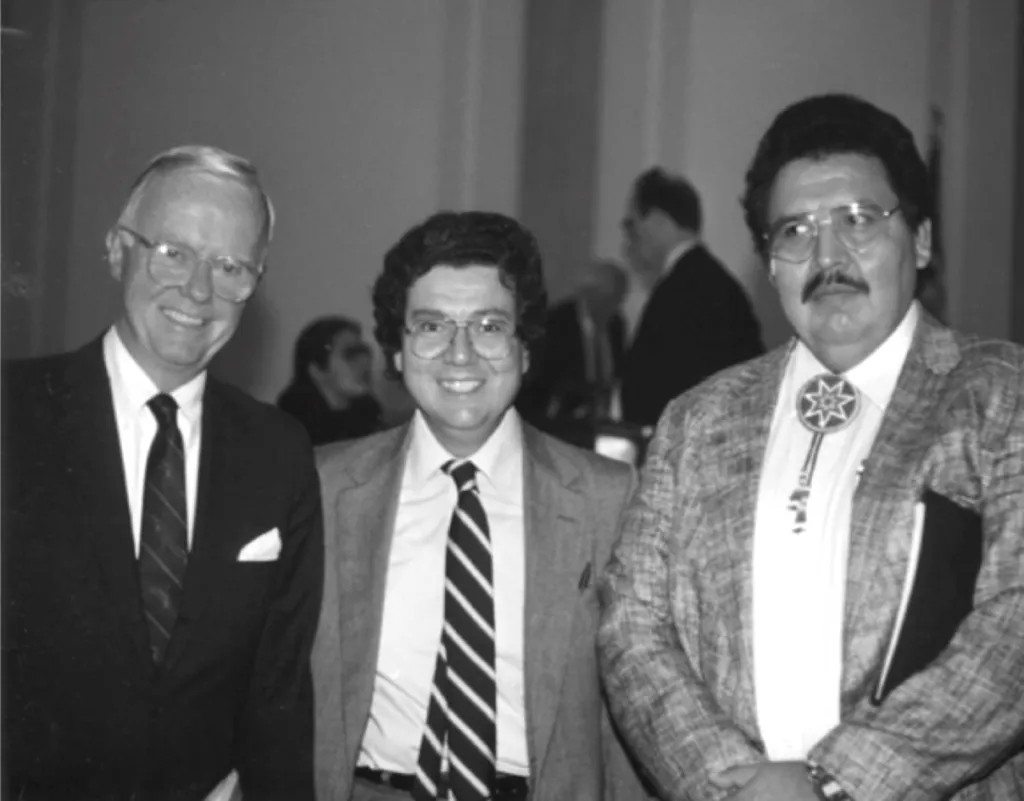
SU staff took a moment to look back on Hauptman’s work and the influence of his scholarship.
“I have used Larry Hauptman’s work for my entire professional life,” said Associate Professor of Religion and author of The Urgency of Indigenous Values Phil Arnold. “Although he was an historian, his work was more than historical. He was a leading light in Haudenosaunee and Indigenous studies. His influence through the Iroquois Research Conference spanned decades. Unlike other “Iroquoianists,” he understood the role of non-native academics who worked with Haudenosaunee people. By using his archival research skills, he enhanced the field of Native American Studies by making his writing, and choice of topics, relevant for Indigenous peoples. He will be missed but his work will live on.
“For my part I would say that Laurence Hauptman left us a legacy of a diverse body of scholarship focused on Haudenosaunee history and culture,” said Scott Manning Stevens, Associate Professor of Native American and Indigenous Studies. “He was major contributor to the field, with books on the treaties and suspect land deals used to dispossess Haudenosaunee land to studies of Haudenosaunee leadership across the centuries and such topics as the impact of the New Deal on the Native nations of New York State. That will work remain for generations of scholars to engage as we further our understanding of Haudenosaunee history.
Hauptman’s influence at the press was deeply felt and his work continues to be celebrated, sought after, and available
“Sadly, I never had the privilege of working with Larry Hauptman, but my colleagues and I Syracuse University Press are all deeply grateful for his long partnership with the Press as a series editor and author,” said Publisher Catherine Cocks. “The many excellent books about the Haudenosaunee peoples that he shepherded to publication are a wonderful legacy.”
“Laurence Hauptman was one of, if not the first, SUP author I met when I came to Syracuse,” said Editor in Chief Heather Stauffer. “In our subsequent conversations and correspondence, his tone might have been quiet, but there was always an energy in his words, a steady reminder that there’s more work for us to do.“
The Press’ thoughts are with the Hauptman family during this time.