
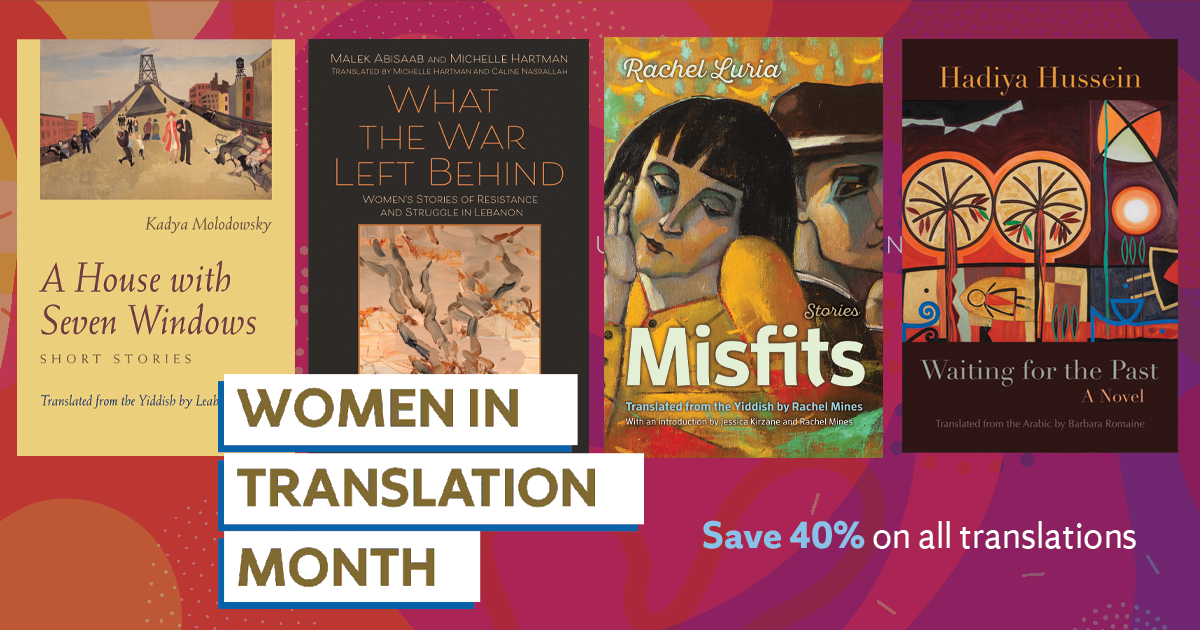
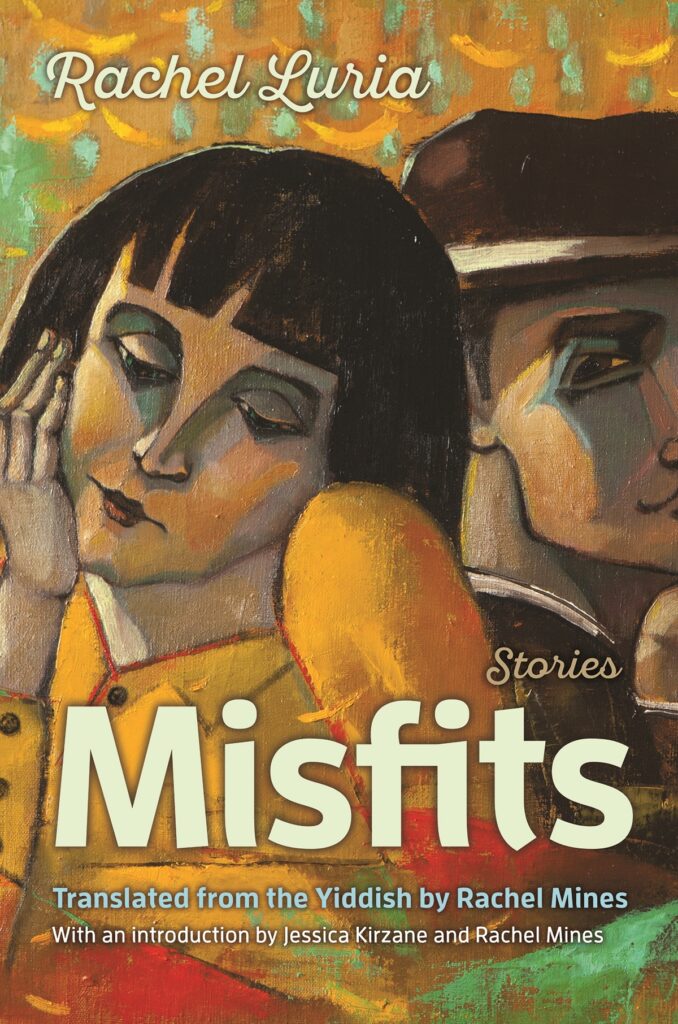
August marks Women in Translation Month, a time to celebrate women authors and translators around the world, working to bring literature to an audience beyond a piece’s native language. As we celebrate, we spoke with Yiddish translator Rachel Mines about her upcoming translation of Misfits: Stories. The collection, originally written in Yiddish in turn of the 20th Century New York by Rachel Luria, features the stories of working class immigrants, revolutionaries, and artists in the city.
What drew you to the work of Rachel Luria and made you want to translate it?
There was a certain amount of serendipity involved. I was browsing around, looking for a new translation project, and downloaded a copy of Modne Mentshn (Luria’s only book-length story collection) from the Yiddish Book Center’s Digital Yiddish Library. I read the first story, which I later translated for Misfits as “A Dollar,” and was immediately hooked by its mystery, drama, power, and pathos.
What creative person has influenced you and your work?
I would have to say the three Yiddish writers whose work I have translated for publication: Jonah Rosenfeld, Rachel Luria, and Isaac Bashevis Singer.
Tell us 3 things about the collection that will resonate with readers.
Luria wrote about the people she was familiar with as a working-class woman in turn-of-the century New York, including factory workers, young married couples, recent immigrants, and political activists. Though the stories were written 100 years ago, their protagonists’ concerns echo those of younger generations today: to find a place in a world of new, changing, and sometimes mystifying social norms and expectations. The stories are short and lively, each a tiny polished gem whose characters and their predicaments invite comparison to the world of today.
What history should readers be familiar with to appreciate these stories?
While a little background knowledge in the history of Jewish immigration to New York and the lives of working-class Jews of the period might be useful, I believe that Luria’s stories speak for themselves.
Luria wrote extensively about the immigrant and working class experience in New York. Were there any striking similarities or differences between what Luria wrote about and today?
Luria’s focus was on Jewish immigrant and working class life in New York, and of course many issues affecting that community – or any immigrant, working class community – are different today. What struck me when reading the stories, however, was that beyond obvious historical developments in politics, career choices, technology, and social norms, her characters struggle with many of the same issues that bedevil us today: how to (or whether to) choose a good marriage partner? How to retain one’s individuality as a wife, husband, or parent? How to get ahead in a job that offers limited opportunities? How to find security in a rapidly changing social environment you don’t understand?

How was the experience of translating Luria different from some of your other recent Yiddish translations?
My two published collections of Yiddish translations are The Rivals and Other Stories and A Plague of Cholera and Other Stories, both written by Jonah Rosenfeld and published by Syracuse University Press. Rosenfeld and Luria are similar in that both take a deeply psychological perspective on their characters. They are different in that Rosenfeld’s stories tend towards the dark and pessimistic, while Luria’s stories, while touching on similar themes, are generally more lighthearted. I enjoyed the experience of translating Luria’s wry observations of early 20th century life: not only the language, but also her tone and ironic humour.
Is there a particular story in the collection that you feel particularly encapsulates Luria’s writing and style?
It’s hard to choose just one! But if you read only one story in this collection, I’d recommend “The Obstacle” for its deeply psychological examination of a young married woman’s internal debate about whether or not to visit an old boyfriend: what does she stand to lose? What does she stand to gain? And what will finally trigger her decision whether or not to act?