

More than a century before contemporary debates about Arab American identity, a Lebanese immigrant woman living in Shreveport, Louisiana, was championing intercultural dialogue and women’s solidarity across cultural divides through the radical medium of the Arabic novel. ʿAfifa Karam (1883–1924) not only wrote groundbreaking fiction, she also theorized the novel as a genre that could empower immigrant women readers at a time when the Arabic novel itself had yet to gain acceptance as a legitimate literary form. Elizabeth Saylor offers the first comprehensive study of Karam’s life and work, recovering a pivotal yet overlooked figure in the Nahda, the Arabic cultural renaissance. Below is an excerpt from the preface of A Bridge too Soon: ‘Afifa Karam and the Arabic Novel in the United States by Elizabeth Saylor, available September 15.
I first encountered ‘Afifa Karam’s writings over fifteen years ago while in graduate school at the University of California, Berkeley– a serendipitous encounter that set me on the path to writing this book. Karam was born in 1883 in ‘Amshit, Lebanon. She immigrated to the United States with her husband, mother, and sister at the age of fourteen in 1897. She was to be come both a prolific contributor to Arabic language newspapers and one of the first Arab women novelists in history. While initially surprise me was the scarcity of references to Karam’s work. Even now, English speakers lack access to her writings, which still exist only in the original Arabic.
Confronting Karam’s elusive legacy initiated my journey from Arabic language archives at the Library of Congress and Harvard University to churches in Brooklyn, New York and ‘Amshit, Lebanon. My explorations also led me to gatherings with members of Karam’s family in Lebanon and in Louisiana and to field trips with my college students to Manhattan’s Lower West Side and Atlantic Avenue, Brooklyn’s first Syrian enclave. Along the way, I learned about Karam’s early life in Lebanon and her immigrant experience in early twentieth-century America. My being an “outsider” to that world, however, only depend my commitment to my subject and sharpened my desire to better understand her and her work. After all, ‘Afifa Karam was herself an outsider.
Three things stand out in Karam’s writing. Fist is her vivid storytelling — grounded as it is in lived experience — to propel her feminist ideas. Next, the intimate relationships among her female characters which stand in stark contrast to male-dominated societies. Finally, Karam’s serpentine navigation of these conflicting spheres that inform her work as a writer and her identity as a person. Tracing these themes back and forth across the Atlantic, carrying their tensions across social and cultural worlds filled me with a profound sense of empathy and admiration. I found my self increasingly sure that her work could point the way to greater tolerance, understanding, and love within the societies of her native Lebanon and her adopted America. These are some of the bridges ‘Afifa Karam traversed, signaled by the title of my book. She intentionally meant for her novels to address the confusion and suffering of her readers, offering them guidance, inspiration, and hopes for lives lived in dignity and peace.
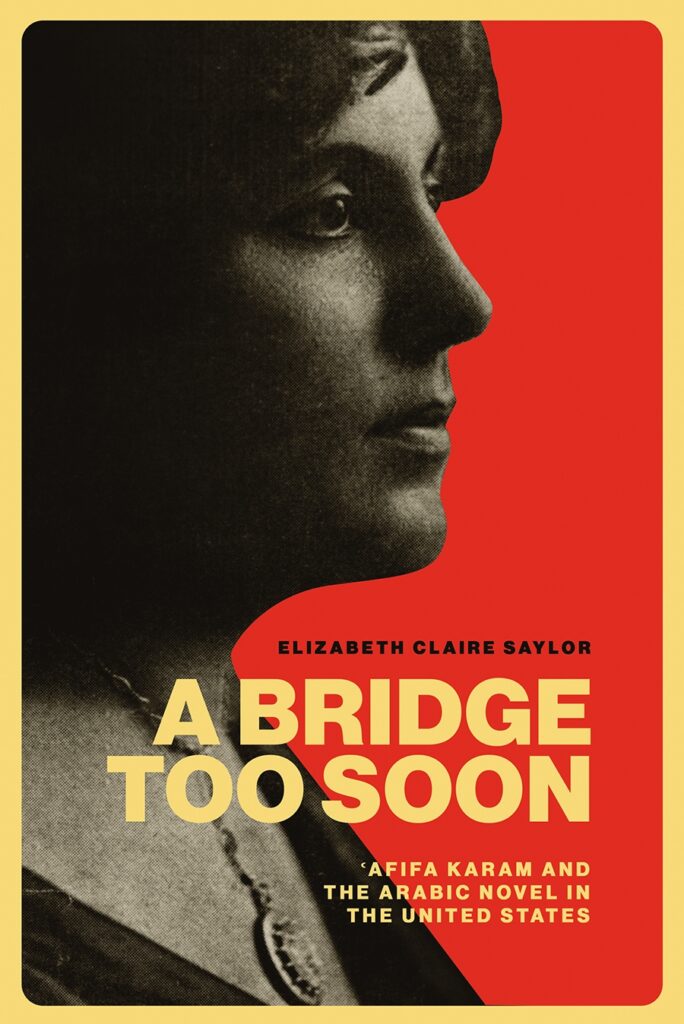
Karam’s years in the United State began in New York City’s “Little Syria,” where her publishers was based. The evidence we have indicates she lived in New York for a relatively short period, including an extended stay in 1911. She lived most of her live Shreveport, Louisiana. Dying at forty-one in 1924, her remains lie in Shreveport’s St. Joseph’s Catholic cemetery, alongside those of her husband and mother. Karam’s novels were published in New York by al-Hoda (Guidance) Press, located from 1902 to 1950 at 81 West Street on Manhattan’s Lower West Side. It was a very diverse neighborhood. There, the Lebanese and Syrian expatriate community –mostly Maronite, Melkite and Antiochian Orthodox Christians as well as some Muslim and Jewish immigrants from the Levant–lived alongside Germans, Irish, Slavs, and Scandinavians. Little Syria brimmed with Arabic culture and language, various daily Arabic newspapers, the aromas of coffee and spices, Arabic music and hymnody. Now, that vibrant activity struggles to be remembered–much like the cornerstone of St. Joseph’s Maronite Church, which was uncovered in the rubble of the attacks on the World Trade Center on September 11, 2001. Despite advocacy, that cornerstone was denied inclusion in the 9/11 Memorial & Museum. Today, it rests at Our Lady of Lebanon Maronite Catholic Cathedral in downtown Brooklyn, a de facto memorial to the community that once brought the likes of Kahlil Gibran, Ameen Rihani, Elia Abu Madi, and other distinguished members of the Pen League to its streets.
In 1897, Karam joined the already extant Arabic-speaking community in Shreveport, Louisiana. Surrounding the Karam family’s stately mausoleum, we notice the names of other Lebanese and Syrians from earlier waves of migration: Abraham, Abood, Albert, Bascilla, Campbell, Eltife, Ferris, George, Haddad, John, Joseph, Khoury, Kloury, Mack, Maroun, Moosy, Monsour, Nasser, Nichols, Salles, and Yazbek. Descendants of those families remain pillars of the Lebanese and Arab American communities throughout Louisiana. Very few speak Arabic today. Now, the mother tongue lingers only in family names and familiar home-cooked dishes–kibbe, laban, waraq, grybee, tabbouleh–all pronounced with a charming Louisiana lilt. These cultural traces are poignant reminders of both the gains and losses that migration and displacement yield in contemporary America.
I once thought that ‘Afifa Karam existed on the margins of the Arabic and American literary canon. I now see her taking her place at the intersection. Karam’s work–like her life–explores the fluidity and complexity of the “in-between” spaces that characterize migrants’ lives/. Her novels push back against clear-cut national and cultural boundaries in a world that has continually been reconfigured by the movement of populations.
‘Afifa Karam offered connections, as attested by readers’ strong responses to her articles and novels. Her story reminds us that Arabic-speaking communities have long been part of America’s diverse fabric. Now, when the multilingual, multicultural, and multiracial nature of American society is under threat, her work reminds us that linguistic and cultural bridges must still be traversed. Karam was a woman writing in Arabic in the diaspora, but she had limited exposure in her native Lebanon and even her adopted America. Theis book is written in a spirit of advocacy and humility meant to celebrate her legacy and ignite new conversation about unrecognized mahajar (Arabic-speaking immigrant) authors. I hope it will provide the impetus for her voice to be heard after much silence so its resurgence can connect us again.