

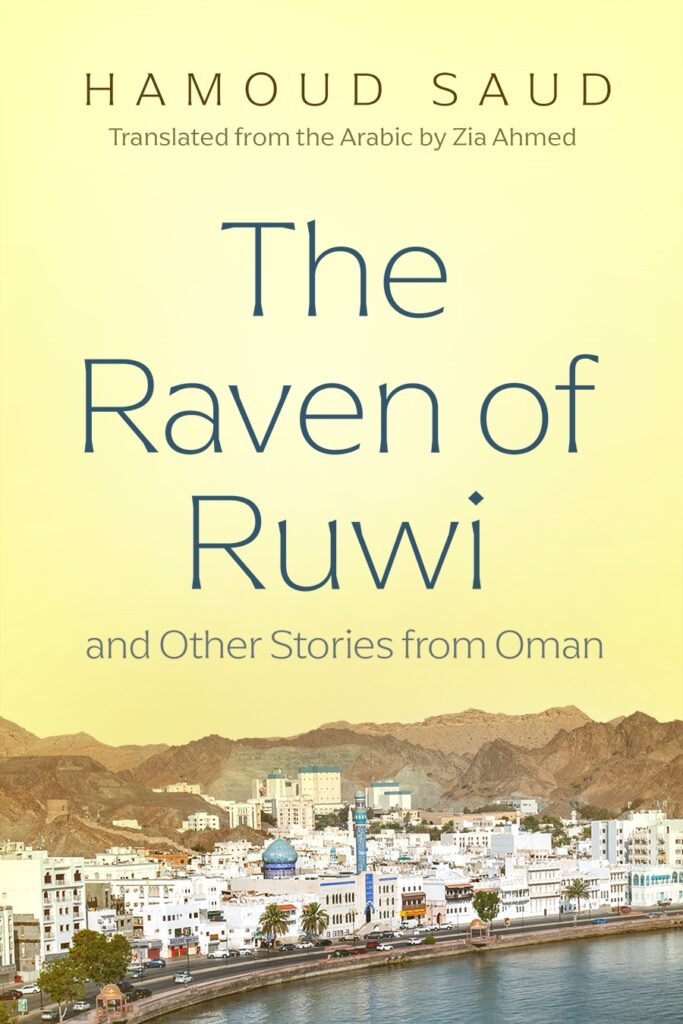
November 10-14 marks University Press Week, when presses come together to celebrate scholarship, collaboration, and sharing academic works across the world. To celebrate this year’s theme of TeamUP, translator of Arabic fiction Zia Ahmed wrote this guest post on his collaboration with writer, Hamoud Saud, on their upcoming book.
I last met Hamoud Saud at Anna Cafe, in Mutrah, the Omani port town just west of the capital Muscat, which has grown to incorporate once distant towns and villages. Ruwi, Wadi Kabir, Bawshar, Qurum: settings for Hamoud’s The Raven of Ruwi and Other Stories from Oman that used to be day treks over treacherous terrain are now easy exits off modern highways.
At the cafe, across the street from the Fish Roundabout (home to a sculpture of two fish, protagonists of one of Hamoud’s stories), we sipped coffee (Hamoud) and karak (me). We talked about how the vagaries of Arabic can conspire with Oman’s cultural melange to trip up the thoughtful translator.
Consider karak, for instance: black tea with milk (preferably evaporated), sugar, and spices, simmered to sublimeness. It’s sold in cafes across Oman, yet the word occurs in no Arabic dictionary. From both the culinary and linguistic perspectives—kaṛak is Urdu for strong or stiff—the ubiquity of masala chai is surprising in a coffee culture until one recalls that the Gulf Arab states run on South Asian labor.
Such subcontinental murmurs in an Arab land can produce head-scratching cognates. Anna Cafe, for instance, is named, not for a namesake of my wife’s, but an extinct Indian and Pakistani coin—āna, sixteen to a rupee—that was also in use over a century ago in the de facto British protectorate of the Sultanate of Muscat and Oman. Long after its minter went metric and a rupee became one hundred paisas, the Pakistani quarter was still colloquially called four ānas. The paisa may have disappeared from South Asian bazaars, but today’s Omani riyal—in a language that has no “p” sound—is worth a thousand baisas.
Down the corniche from Anna Cafe is Mutrah Souk, a recurring landmark in Hamoud’s stories, known to locals as Sūq al-Ẓalam (Market of Darkness). I asked Hamoud for an etymology for the name, expecting a dark and untranslatable history. The reality was more prosaic: the souk had started out as rooms in people’s homes, which evolved into shops and corridors covered with palm leaves to block out the sun. Before electricity came to Oman, in the late 1970s, the souk was, quite literally, dark.
Extinct coins, transplanted tea, and a market of darkness: these are just a few of the sociolinguistic conundrums that this non-Arab translator couldn’t have cracked without close collaboration with a most patient and forgiving author. The act of translation can be a leap in the dark. It’s a leap I could never have taken without Hamoud Saud.