
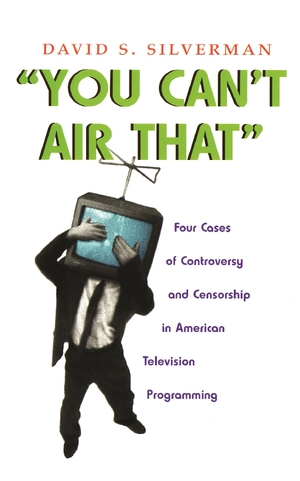
"Many books have referenced television's most controversial battles, but few have gone into as great depth as David Silverman has. You Can't Air That illuminates what is at stake when mainstream television confronts
content that it deems objectionable."—Ron Simon, curator, The Paley Center for Media"[Silverman] captures the essence of the need to represent the underrepresented on television, and he presents the minefield television producers face whenever they attempt social commentary that runs contrary to the corporate line. . . . and fills in some major gaps in censored television's history."—Mason Williams, head writer, The Smothers Brothers Comedy Hour
Description
Broadcast television’s presentation of controversial material to a mainstream American audience is no less an issue today than it was in the 1940s. Programming content has always been a product of the interests and motives of network executives, advertisers, and regulatory agencies. In this illuminating book, David S. Silverman assesses four controversial television series from the perspective of media history, examining the censorship present at all networks and the political and intellectual inertia it produces in broadcast television.
Beginning with The Smothers Brothers Comedy Hour from the sixties, the author analyzes the split between the comic team and CBS over remarks they made on the Vietnam War and religion. He also examines The Richard Pryor Show of the seventies, which raised strong questions about network meddling over racial issues. Among recent personalities he discusses activist Michael Moore, whose frank political views wreaked havoc for NBC and Fox in the mid-nineties, and Bill Maher whose candid thoughts on 9/ 11 led ABC to terminate Politically Incorrect.
Drawing on firsthand accounts by the writers, producers, and performers of these programs, Silverman offers an unbiased view of the ways in which censorship, sponsor intimidation, regulation, and network tampering forced American broadcasters to manipulate creative talent and stifle genuine controversy. Shedding new light on the prevalence of censorship in broadcast television, this book helps to reinvigorate the subject of free speech in American society.
Table of Contents
1. Television Censorship and Regulation: An Introduction
2. Tuned In, Turned On, Then Kicked Off: The Smothers Brothers Comedy Hour
3. “When You Hire Richard Pryor, You Get Richard Pryor:” The Richard Pryor Show
4. Two Networks, One Emmy, and the Same Outcome: TV Nation
5. Do Not Relinquish the Right to Criticize: Politically Incorrect with Bill Maher
6. Discussion and Conclusions
Works Cited
Index
About the Author
David S. Silverman is assistant professor of communications arts at Valley City State University, North Dakota.
October 2007