
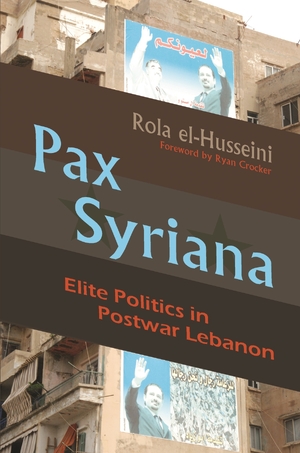
"An excellent primer on Lebanese politics of this period, the book also situates its subject in the context of post-World War II Lebanese political history. . . . Pax Syriana has much to teach anyone interested in Lebanese politics, society, and history."—International Journal of Middle East Studies
"A well-researched and carefully crafted book which will be of interest not only to students of Lebanese politics but also to students of elite politics. The book’s clear exposition makes it accessible to undergraduates and seasoned researchers alike."—Middle East Journal
Description
The recent political history of Lebanon has been defined by the legacy of war. In addition to repeated external invasions and the ongoing presence of foreign troops of diverse nationalities, the Lebanese people have endured the scars left by a bitterly contested civil war that began in the spring of 1975 and continued unabated for the next fifteen years. While much has been written about the tragedy of the civil war, el-Husseini’s Pax Syriana is the first book focused on the evolution of the postwar political scene.
In a series of negotiations brokered by Saudi Arabia, under the auspices of the larger international community, the civil war came to an end with the signing of the Ta’if Agreement. This agreement ushered in an era of Syrian control and rule by a disparate group of power elites. El-Husseini provides an in-depth account of how the political elite left an indelible mark on the Lebanese state and society. Through extensive field work and firsthand interviews, el-Husseini offers an intimate portrait of postwar Lebanon and shows how the Syrian influence brought a degree of stability to this fragmented nation and yet simultaneously undermined the development of a full constitutional democracy as Lebanon began to acquire some of the authoritarian character of the Syrian regime.
Table of Contents
Foreword, Ryan Crocker
Acknowledgments
Note on Transliteration
Introduction
1. The Lebanese Political System: The Elite Pacts of 1943 and 1989
2. Postwar Elite Interaction
3. Political Parties
4. State Elites and the Legacy of Corruption
5. Strategic Elites
6. Emerging Elites and the Absence of Women from Politics
7. Elite Attitudes on Syria and Sectarianism
Conclusion
Who’s Who of Lebanese Politics
Lebanese Political Timeline (1989–2005)
Notes
Glossary of Arabic Terms
Bibliography
Index
About the Author
Rola El-Husseini is assistant professor at the Bush School of Government and Public Service at Texas A&M. Her articles have appeared in the Middle East Journal, Orient, Comparative Studies of South Asia, Africa, and the Middle East, and Third World Quarterly.
December 2012