
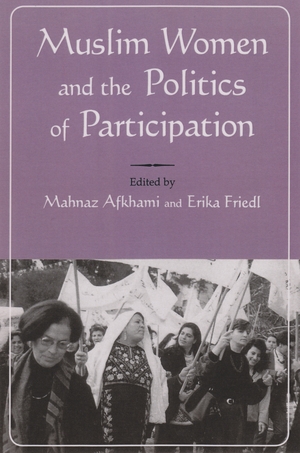
Description
At the Fourth World Conference on Women in Beijing, the international community accepted women’s rights as human rights, and with it the charge to work toward the full integration of women in the affairs of their respective nations. Muslim Women and the Politics of Participation is about ways of promoting women’s participation in the affairs of Muslim societies: from raising consciousness and changing codes of law to penetrating the economic markets and influencing national and international policies. Editors Mahnaz Afkhami and Erika Friedl challenge stereotypes about Muslim women and probe the difficulties and possibilities women face as they work for positive social change. Sixteen activists and politicians from international organizations—most from Muslim countries discuss, for the first time, major issues relevant to Muslim women striving to achieve their human rights through political participation.
Table of Contents
PART ONE: Assessing Women's Rights Issues in Muslim Societies after Beijing
1. Beyond Beijing: Obstacles and Prospects for the Middle East, Deniz Kandiyoti
2. Fundamentalism and Women's Rights: Lessons from the City of Women, Boutheina Cheriet
3. Women, Islamisms, and State: Dynamics of Power and Contemporary Feminisms in Egypt, Azza M. Karam
4. Aberrant "Islams" and Errant Daughters: The Turbulent Legacy of Beijing in Muslim Societies, Ann Elizabeth Mayer
PART TWO: Strategies for Change
5. Muslim Women's Islamic Higher Learning as a Human Right: The Action Plan, Nimat Hafez Barazangi
6. Imagination as Subversion: Narrative as a Tool of Civic Awareness, Azar Nafisi
7. Personal Status Codes and Women's Rights in the Maghreb, Fati Ziai
8. Leadership Development for Young Women: A Model, Sharifah Tahir
9. The Women Studies Program in Palestine: Between Criticism and New Vision, Eileen Kuttab
10. Imperiled Pioneer: An Assessment of the Institute for Women's Studies in the Arab World, Laurie E. King-Irani
11. Claiming Our Rights: A Manual for Women's Human Rights Education in Muslim Societies, Mahnaz Afkhami
PART THREE: International Organizations and the Implementation of the Platform for Action
12. International Human Rights Organizations and Advocacy for Change, Maryam Elahi
13. International Organizations, National Machinery, Islam, and Foreign Policy, Mervat Tallawy
14. Muslim Law and Women Living under Muslim Laws, Seema Kazi
15. Gender Equality and the World Bank, Roslyn G. Hees
16. UNIFEM and Women's Climb to Equality: No Turning Back, Noeleen Heyzer and Ilana Landsberg-Lewis
Notes
Bibliography
Index
About the Author
Mahnaz Afkhami is the executive director of Sisterhood Is Global Institute (SIGI). She is the editor of Faith and Freedom: Women’s Human Rights in the Muslim World.
Erika Friedl is The E.E. Meader Professor Emerita of Anthropology at Western Michigan University. She is the author of several books including Women of Deh Koh, Children of Deh Koh, and Folktales and Storytellers of Iran: Culture, Ethos and Identity.
Related Interest
November 1997