
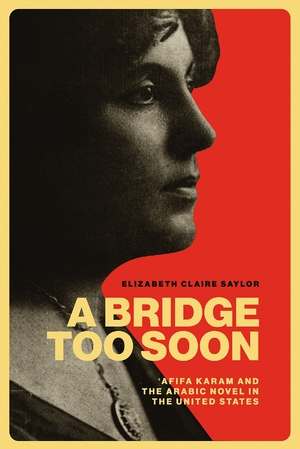
"In some ways the child of her time, in other ways far ahead of her time, Karam is a complex writer and intellectual who demands the meticulous and long overdue attention that Elizabeth Saylor affords her."—Waïl S. Hassan, editor of The Oxford Handbook of Arab Novelistic Traditions
"This important book makes a needed contribution to its field. It adds substantially to the corpus of scholarship in SWANA studies and provokes a new way of thinking about the place of women writers in the literatures of the modern Mahjar."—Stacy D. Fahrenthold, author of Unmentionables: Textiles, Garment Work, and the Syrian American Working Class
"In her careful analysis of Lebanese-American ʿAfifa Karam’s intercultural and interfaith novels, Saylor has realized the ambition of all feminist historians—retrieve, amplify, and celebrate women writers whom history has ignored."—miriam cooke, author of Dancing in Damascus: Creativity, Resilience, and the Syrian Revolution
Description
More than a century before contemporary debates about Arab American identity, a Lebanese immigrant woman in New York City was championing intercultural dialogue and women’s solidarity across cultural divides through the radical medium of the Arabic novel. ʿAfifa Karam (1883–1924) not only wrote groundbreaking fiction; she also theorized the novel as a genre that could empower immigrant women readers at a time when the Arabic novel itself had yet to gain acceptance as a legitimate literary form.
Elizabeth Saylor offers the first comprehensive study of Karam’s life and work, recovering a pivotal yet overlooked figure in the nahda, the Arabic cultural renaissance. Drawing on Karam’s journalism in the New York-based newspaper al-Huda and her three published novels, Saylor reveals how this writer, journalist, and translator developed a distinctly gendered theory of fiction while addressing the urgent questions facing Syrian immigrants navigating between Arab and American cultures. Karam’s novels—Badiʿa wa-Fuʾad, Fatima al-Badawiyya, and Ghadat ʿAmshit—feature heroines who embody hybrid identities, forge unlikely cross-cultural friendships, and resist patriarchal oppression both in their ancestral homeland and their adopted country. Karam emerges as a bold social critic and literary innovator whose work remains strikingly relevant to contemporary discussions of transnational feminism and cultural hybridity.
About the Author
Elizabeth Claire Saylor is assistant professor of Arabic at North Carolina State University.
September 2026