
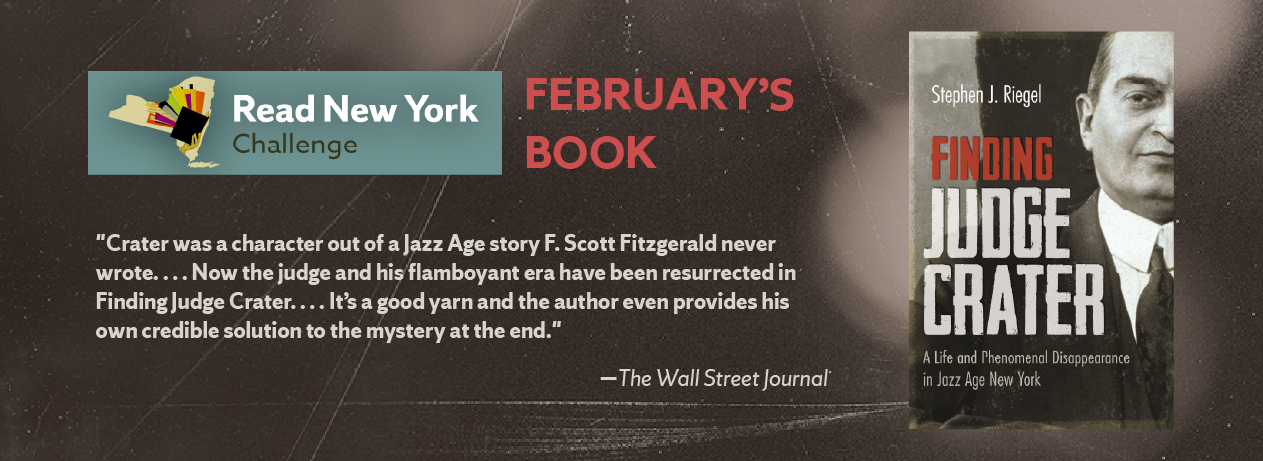
The Read New York Challenge is going strong. This February’s book was “Finding Judge Crater: A Life and Phenomenal Disappearance in Jazz Age New York” by Stephen Riegel. The book, published in 2021, details the infamous disappearance of Judge Joseph Crater, a prominent and newly appointed figure in 1930s Manhattan politics whose disappearance shocked a nation and prompted a mystery that remains unsolvede to this day. Riegel’s book examines Crater’s final known days, as well as following theories as to where Crater’s final resting place is and the identity of those behind his likely murder.
“Finding Judge Crater” received a lively response at publication, including a review in the Wall Street Journal, which examined the compelling mystery and character of Crater. The iconic mystery and the nature of Crater’s disappearance was highlighted by other media, including on the Vanished podcast, which hosted an interview with Riegel about the book and case. Since publication, many more reviews and coverage of the book have examined the way the story pays special attention to the unique character of Jazz Age New York’s political scene. A review in Ellery Queen Mystery Magazine notes:
Riegel immerses readers in the riotous nightlife of 1920s Manhattan, where the elite rubbed shoulders with the underworld in a mutual pursuit of Prohibition-restricted booze. When he was not enjoying this nocturnal playground, Crater was making his name as a Tammany Hall foot soldier, and the author plumbs the corrupt depths of the city’s notorious political machine. Governor Franklin Roosevelt had just rewarded the forty-one-year-old with a coveted judicial appointment when he disappeared.
Riegel was featured on several interviews about the book and case as well, including a conversation with Buzzfeed Unsolved and fellow members of the Princeton class of 1979.
As part of the Read NY Challenge, we reached out to Riegel to get his thoughts on the book since publication and readers continuing to find the book since publication.
I’ve been pleasantly surprised at the reception of my book. Although Justice Crater’s disappearance has little name recognition almost a century later, I have had numerous requests for interviews about my book from history and true crime podcasts, new book blogs and radio and television shows. I think the response was partly due to New Yorkers’ and its visitors’ greater familiarity with the case but mainly because of the current cultural obsession with true crime and cold cases. The resurrection of the Crater disappearance was exemplified by its inclusion as an episode in the popular “History’s Greatest Mysteries” series on The History Channel in March 2023. My book being made into an AudioBook was also unexpected.
In addition to the many favorable reviews of my book in newspapers, magazines and journals and on radio shows, podcasts and videos on the Crater case continue to be posted, some referring to and recommending it to readers. I’m gratified that the theory of why and how the missing judge vanished advanced in my book has been described as the most plausible and convincing explanation of this unsolved mystery, as this was my primary objective in writing it.
There have been no new developments about the Crater case since publication of my book that I am aware of. I’m considering as a follow-up to my hypothesis of where Crater was killed and potentially buried, to get the permission of the current owner of the Yonkers “farmhouse” referred to in my book (which presently is an ophthalmologist’s office), and scan with new technologies the ground under the cellar and backyard of the house for human remains.
I’ve started work on my next project which is about the Jamaican immigrant, Marcus Garvey, and his leadership of the first Afro-American mass movement in the United States in the years following World War I, and its destruction by the federal government’s controversial prosecution of him for fraud in 1923.
Interested in signing up for the Read New York Challenge? Find out how you can get a year worth of free e-books and more here and prepare for March’s selection, “The Soul of Central New York: Syracuse Stories” by Sean Kirst.