

October’s selection for the Read New York Challenge is Resting Among Us: Authors’ Gravesites in Upstate New York by Steven Huff. The book tracks the final resting places of dozens of renowned authors as well as Huff’s research and reminiscences about each, making for a lively, if occasionally macabre, autumn read.
To celebrate Halloween, below is an excerpt adapted from two chapters of the book, highlighting the work and graves of two writers who left an enduring mark on 20th Century popular culture, Rod Serling, the creator of The Twilight Zone, and Fran Striker, who created The Lone Ranger as well as a host of other pulp characters.
[Excerpted from Resting Among Us Authors’ Gravesites in Upstate New York, by Steven Huff, Copyright Syracuse University Press, 2023, All Rights Reserved]
When they rolled the credits at the end of each [episode], Serling’s Cayuga Productions company escaped my notice. But Upstate New York associations were at work. He and his family had a summer home on Cayuga Lake, one of the longest of the Finger Lakes, running from near Seneca Falls all the way down to Ithaca.
***
In the spring of 1975 Serling had a couple of heart attacks, and after two weeks in Thompkins Memorial Hospital in Ithaca, he went by ambulance to Strong Memorial Hospital in Rochester for open-heart surgery, which was still a risky procedure then. He was a serious smoker, and he even convinced the paramedics to stop along the way so that he could get out and have a cigarette. On June 28, he died of complications following surgery, aged fifty, leaving his wife Carol, and daughters Jodi and Anne.
Rod Serling is buried in Lake View Cemetery in Interlaken, in Seneca County. From the Thruway, take Route 96 South, approximately 67 miles. Look for County Road 150, about three-quarters of a mile north of the Interlaken village. You’ll turn east. Or key into your GPS: 3675 County Road 150, Interlaken, NY, 14847. When you turn into Lake View Cemetery, you’ll see a chapel to your left, on the rear of which is a list of plots and a map. Serling is in Section 6, Plot 1044, and the map may come in handy, since the cemetery is a maze of winding dirt paths. Make your first right on the car path and keep making right turns until the path circles around to the left on the east end of the cemetery. At about the point where you’re heading west again, pull over and park. Serling’s place is atop the knoll to your right, in the shade of a large maple.
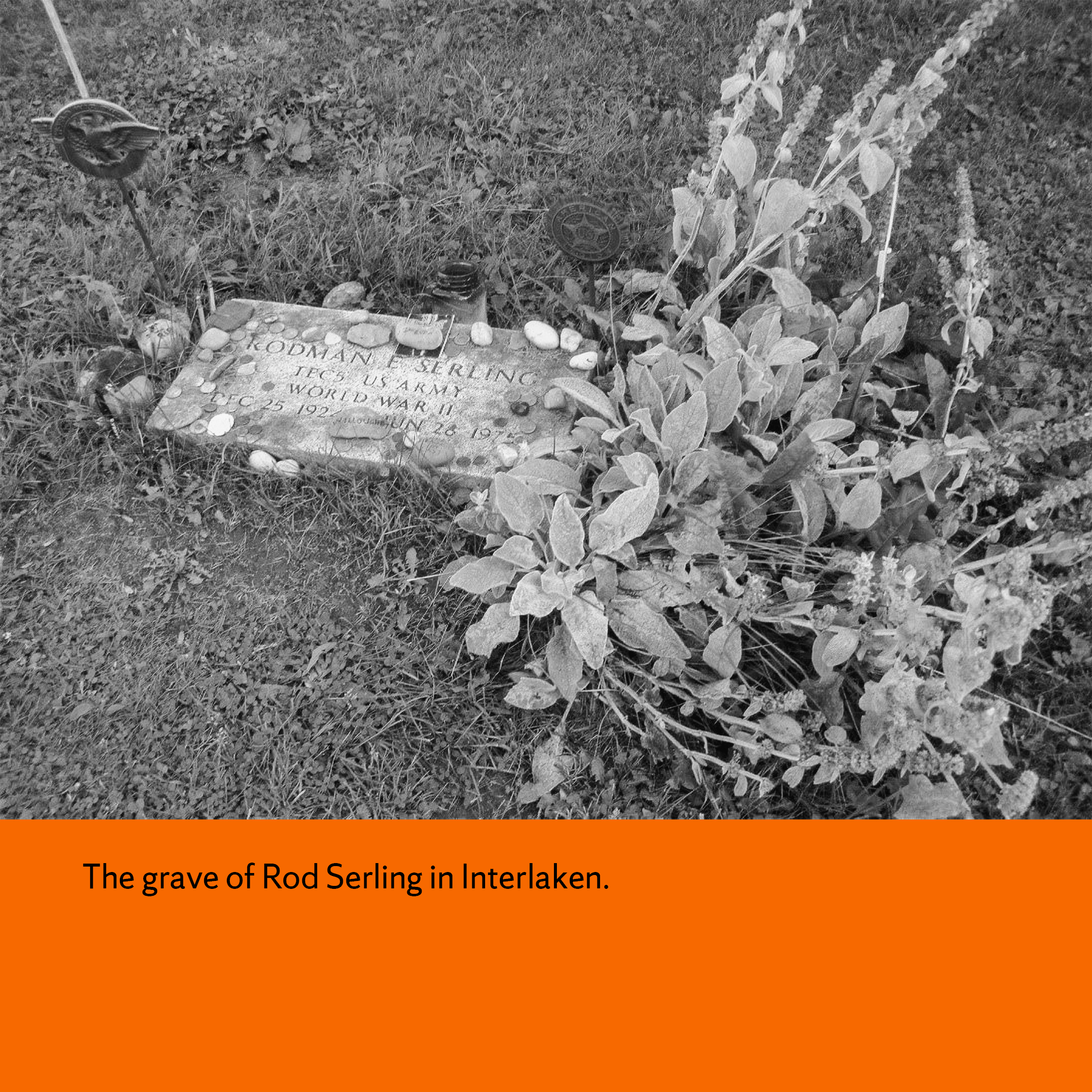
As with many writers, he has a humble marker, but one of the most decorated by visitors that I’ve found; in fact, it is rivaled only by Carl Sagan’s marker. When I visited, the stone was a bit crowded by a lamb’s ear planting, dozens of small coins, a skeleton key, and a small stone on which was written, “Miss you Dad.” I left a chip of sea glass. Tucked between the lamb’s ear and the stone was a full pack of Marlboros. So, we know what brand he smoked. Same brand as me, when I still smoked.
Before the New York State Thruway and other major freeways were built, it was an advantage for a town to be at the crossing of two or more well-traveled roads. Nowadays, if a crossroads town seems somewhat out of the way, it’s good to remember that old travel routes once gave it an edge. The village of Arcade, where Routes 98 and 39 converge, is part of the town of Arcade in the southwest corner of rural Wyoming County, about forty miles southeast of Buffalo. As with Ithaca and Rushford, and a few other towns in this book, there is no quick freeway-route. But the rolling hills make some of the loveliest farm country in the state, now dotted by enormous windmills that in recent years have popped up like mushrooms, dutifully grinding out electric power, so common now that one hardly notices them.
It’s home to the Arcade and Attica Railroad, an antique rail line that offers train excursions pulled by an old-fashioned steam locomotive, although it doesn’t go to Attica now, but to North Java, about halfway. Arcade was once also the home of Fran Striker. He was one of the most successful creators of modern adventure heroes.
His work was formulaic, of course, and he was in no danger of winning a Pulitzer Prize. But it has fascinated me that a man could sit at a typewriter with a thermos of coffee and a pack of cigarettes and bang out one story, one script, one book after another. Of all the authors covered in this volume, only Walter B. Gibson, author of The Shadow novels, probably turned out more words.
The Lone Ranger series was first broadcast in 1933 on the Buffalo radio station WEBR where Striker—who was born in Buffalo—was a scriptwriter and announcer. After Striker moved to WXYZ in Detroit, the station owner George Trendle pressured him to sign over rights to the Lone Ranger character. After that, Trendle was credited as creator on episodes of The Lone Ranger. It’s hard to imagine why Striker would let go so quicky. Maybe because it was the height of the Great Depression, good paying jobs were hard to come by, and he had a family to support. Or, maybe he didn’t realize what a gold mine he possessed. In 1954 Trendle sold the rights to the Wrather Corporation for $3 million.
Just an aside: Jay Silverheels, born Harry J. Smith, who played Tonto in the TV productions of The Lone Ranger as well as roles in Key Largo, Broken Arrow, and The Man Who Loved Cat Dancing, was a Native American from Ontario, Canada. As a professional lacrosse player in the 1930s, before his Hollywood days, he played on indoor teams in Toronto, Buffalo, Rochester, Atlantic City, and Akron, New York. He was discovered by a movie scout when he played lacrosse in Los Angeles.
Striker gave our culture some iconic phrases. The “silver bullet” nowadays usually pertains to a single thing or ingredient that truly works. And “Who was that masked man?” There was Tonto’s affectionate name for his masked sidekick, “Ke-mo-sah-bee.” The yell with which the Lone Ranger roused his horse Silver to action: “Hi-yo Silver! Away!” is probably as immortal as Johnny Weissmuller’s Tarzan yodel.
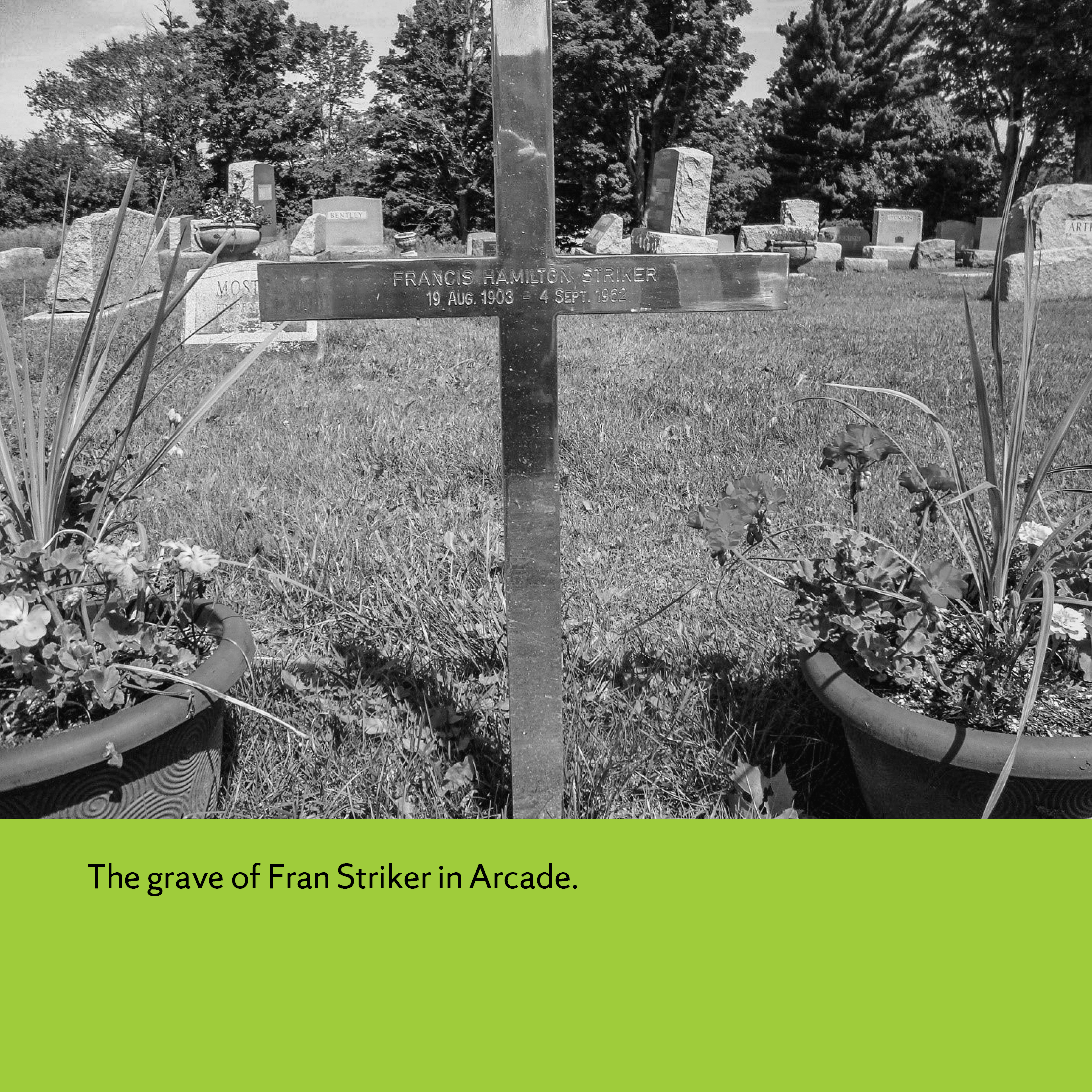
Fran Striker is buried in Arcade Rural Cemetery. Either of two streets in the center of the business district, Prospect and Park, will take you to the cemetery, situated on a hillside. However, I advise caution: the paths up the hill, if you decide to drive them, are narrow, bordered in places by sobering drop-offs. To reach this point with your GPS, key in: 107 Park St., Arcade, NY, 14009.
The place you are aiming for is the very top of the hill, on the opposite end of the cemetery from the entrances, where the path curves near a neighboring field. Look for a row of four stainless steel crosses a short distance from a maple tree on the corner of the path. They are fairly easy to pick out because they are unlike other markers in the cemetery. The second from the left is Francis Hamilton Striker. More steel crosses nearby include their three sons, one of whom, Fran Striker Jr., finished his father’s last novel, One More River.