
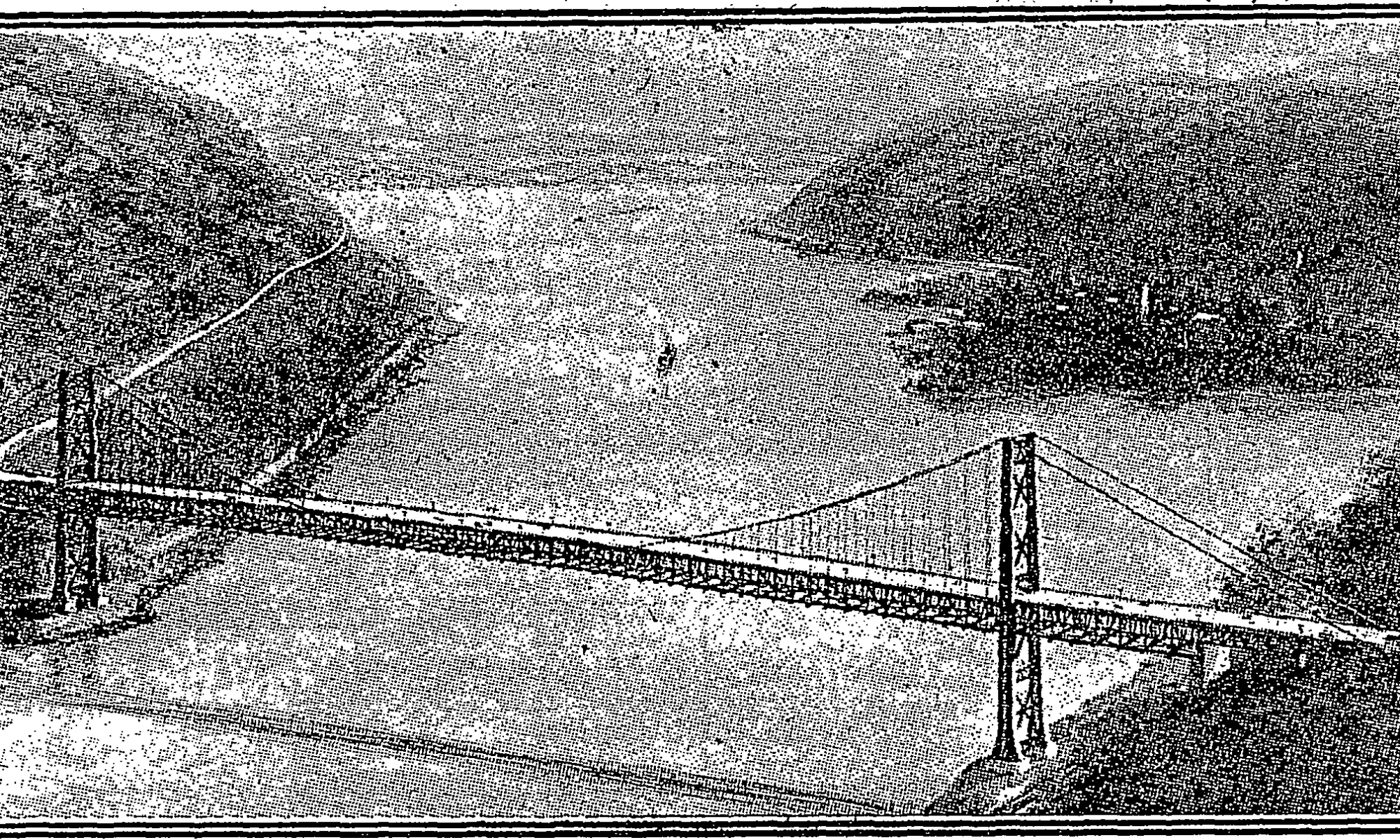
Steel and Grit: A History of the Lower Hudson Valley and the Bear Mountain Bridge explores the story behind the bridge’s construction as well as the fundraising and community-led efforts that radically reshaped the region. In this excerpt, Barbara Cali takes readers behind the scenes of the opening day celebration.
The parade of cars carrying the many guests invited to the opening-day festivities for the Bear Mountain Bridge reached the eastern-approach roadway of the newly completed span just as the fifty-piece West Point Band broke into “The Star-Spangled Banner.” The automobiles pulled to a stop, and the occupants began to disembark and walk about, taking in the spectacular views of the Hudson River laid out before them. Thirty-five minutes earlier, they had assembled at the Peekskill train station, and then, following directives, they formed a procession of motorcars and made their way toward the bridge. The long cavalcade advanced, exiting the railroad station at South Street and moving slowly along Division Street to Highland Avenue, around the State Camp, up the new highway, past the toll gate, and finally on toward the bridge. Each car was decked out in red, white, and blue streamers fluttering in the breeze.
Anticipation permeated the air. After twenty months of construction, the Bear Mountain Bridge—the first Hudson River crossing south of Albany—was ready to open to the public! At 1,632 feet, it was the longest suspension bridge in the world—a title it would hold for nineteen months before the Benjamin Franklin Bridge in Philadelphia took the title for itself. Those guests invited to the ceremonies were, no doubt, feeling very smug as they presented the card, issued as part of their invitation, that gave them access to the bridge and roadway approaches a day before they opened to the general public. Special travel arrangements had been made for the 110 guests arriving from New York City; two coaches were added to train number 1 on the Erie Line, leaving Grand Central Terminal at 10:00 a.m. that morning and arriving at the Peekskill station at 11:10 a.m. Charles J. Donohue and his partner, H. Field Horne, Peekskill’s local Studebaker agents, had been entrusted with providing enough Studebakers to transport those guests arriving by train and any residents who did not own a car. (Some guests drove from the train station to the ceremony in their vehicles, and if they had room for additional passengers, they welcomed them.) All told, Horne and Donohue provided thirty-one Studebakers.
Once the anthem finished playing, the guests were asked to please return to their vehicles and line up four abreast. At exactly 12:00, the band started to march. An assortment of festive tunes was played as they crossed the bridge with the parade of cars following closely behind. As the West Point musicians reached the west side of the span, everyone came to a halt. The cars positioned on the bridge measured forty lengths long, a total of 160 vehicles. All passengers then disembarked once again and gathered around the west-end tollhouse. Two large American flags draped the ends of the bridge, and hundreds of smaller flags representing different nations around the world were strung end to end along each side of the bridge, further producing a festive atmosphere.
All eyes were directed to a small platform near the western tollhouse where E. Roland Harriman, president of the Bear Mountain Hudson River (BMHR) Bridge Co., was standing ready to begin the ceremonies. Roland joined Frederick Tench, the bridge contractor, to champion the project after Tench solicited his assistance back in 1921. As a principal in his brother’s financial firm, W. A. Harriman and Co., Roland was able to organize a group of investors that evolved into the Bear Mountain Hudson River Bridge Co., the entity that ultimately funded and managed the project. On the platform, alongside Roland, stood his mother, Mary A. Harriman, widow of the late railroad financier E. H. Harriman. Also present was Wilson Fitch Smith, the chief engineer who had overseen the construction on behalf of the company. Harriman opened the festivities with a speech, giving the crowd a well-detailed background of the bridge construction and progress, which, he made clear, came in fits and starts. Then Mrs. Harriman, carrying a beautiful bouquet of red roses, proceeded to an area draped with two American flags and ceremoniously pulled a cord revealing to the crowd a bronze plaque mounted on the bridge.
The inscription read:
BEAR MOUNTAIN BRIDGE
THE FIRST HIGHWAY BRIDGE TO SPAN THE HUDSON RIVER SOUTH OF ALBANY
BEGUN MARCH 24, 1923—OPENED NOV. 27, 1924
TO ALL WHO
WITH THOUGHT LABOR AND LOYALTY HAVE
CONTRIBUTED TO THE CONSTRUCTION OF
THIS BRIDGE AND HIGHWAY
THIS TABLET IS INSCRIBED
TOTAL LENGTH OF BRIDGE 2257 FT. LENGTH OF SUSPENSION SPAN—1632FT.
HEIGHT OF TOWERS 355 FT. CLEAR HEIGHT ABOVE RIVER—153 FT.
DIAMETER OF CABLES 18 INS. NUMBER OF WIRES IN EACH CABLE—72524
Smith stepped up to the podium and introduced himself to the crowd. He praised the artisans and workers involved in the project: “The ceremonies you have just witnessed here were but simple acts,” he declared. “But they are important acts in the life of the Empire State. They signal the opening of an important course of traffic and the removal of the barrier which has blocked the southern portion of the State.
Amid the high-pitched chatter that immediately followed the speeches, the West Point Band again took up their instruments and began to play. At the same time, newspaper reporters and photographers at the scene snapped photos of the Harrimans and other assembled dignitaries. Motion-picture photographers were strolling about, capturing the event from start to finish for posterity.
During the previous two or three years, local papers, such as the Peekskill (NY) Highland Democrat and the Middletown (NY) Daily Herald, as well as the prestigious New York Times, had been filled with nothing but talk of the bridge, providing much fodder for speculation among residents. Initial stories reported on little more than the issuance of state and federal approvals for the bridge, but from the first suggestion that a bridge might be built across the Hudson at the chosen site, gossip began to circulate. Conjectures about the bridge’s specifications regularly appeared along with assumptions about the cost and the source of funding. Much of the information was preliminary and often varied according to which publication was reporting. There were unending discussions on what the impact of the bridge would be on the immediate region and the entire state. It was reported that for the first time, citizens would be able to cross the river without waiting in line for ferries—which, of late, were having difficulty keeping up with the volume of automobiles and during the winter were not available when the Hudson was frozen. Access to the parks on the western shore of the Hudson would soon be easily available to residents of New York City and the surrounding towns and hamlets. The impact on commerce was expected to be great as well: now goods arriving at the rail terminals in New Jersey would be immediately loaded onto trucks and proceed on the journey to New York City without the need for loading and unloading onto and off barges to cross the New York Harbor.
Once the design was released, there was no shortage of opinions as to the beauty of the monument (or lack thereof) and whether it was worthy of its place on the river. After construction began on the bridge in March 1923, the stories exploded, offering new reports to readers as each phase of the project was completed.
The project had been plagued by delays during the first sixteen months of construction, but a remarkable turnaround occurred in the summer of 1924 when job reports noted that a new, accelerated pace had taken hold, and one by one each requirement fell into place. A hint that completion was imminent came in August 1924 when Roland Harriman wrote to council members of the Peekskill community regarding road repair. In a letter to Cornelius A. Pugsley, dated August 11, 1924, Harriman expressed his concern that local roads should be inspected and repairs made so they would be ready to handle the increase in traffic the new bridge was expected to bring, thereby preventing any “neck of the bottle” conditions. Pugsley was a lifelong resident of Peekskill, an active member of the local government, as well as an investor in the bridge, and an officer of the BMHR Bridge Co.
By the end of October, it was clear that the bridge would be ready within the next month. Roland wrote to the governor of New York, Alfred E. Smith, and informed him that the bridge would open for traffic on Thanksgiving Day, November 27, 1924, and the Bear Mountain Hudson River Bridge Co. was planning to hold an event the day before to celebrate the occasion. He asked the governor to “officiate at these ceremonies and to be our guest of honor at a luncheon to be served at the Bear Mountain Inn directly afterward.” Unfortunately, the Honorable Alfred E. Smith was already otherwise engaged and therefore had to decline the invitation. Roland continued to manage the list of invitees, often writing personal notes to close friends and dignitaries, asking several of them to speak a few words at the luncheon. In addition to Governor Smith, dignitaries solicited by Roland included Herbert Hoover, secretary of the interior; John W. Weeks, secretary of war; General F. W. Sladen, major general and superintendent of the United States Military Academy at West Point; and Benjamin B. Odell, former governor of New York, to name a few. The resultant guest list numbered in the hundreds. Plans moved forward with anticipation and excitement.
The hundreds of news articles that had appeared over the years about the bridge, to say nothing of the rumor mill, fed the mounting excitement and anticipation of the locals. After all the talk, the bridge was now a reality. The following morning, at 7:00 a.m., Thanksgiving Day, the bridge would finally be open to public traffic. But today those special few invited to the bridge’s inauguration would gather to celebrate!