

Today marks the beginning of UP Week, an opportunity to celebrate the work of University Presses around the world as we foster collaboration between academics and celebrate the spread of information. This year’s theme is “Power UP, ” illustrating the many ways that university presses fuel publications and projects that inform our current moment and shape our future. To write on the topic, today, we have a guest post from Kenny Fries. Kenny Fries is the author of In the Province of the Gods ; The History of My Shoes and the Evolution of Darwin’s Theory; and Body, Remember: A Memoir. He edited Staring Back: The Disability Experience from the Inside Out. His books of poems include Returns: Poems Selected and New. In the Gardens of Japan, Desert Walking, and Anesthesia.
Historically, work by disabled writers has been marginalized, or ignored. Disabled writers did not have access to education and training. Our literature has too often been viewed as “therapy,” rather than the literature it actually is. Similarly, much of disability history, has not been recorded, or not remembered.
Because of this the lineage of disabled writers is often a disconnect. It’s challenging for younger disabled writers to find their “mentors,” and peers. Too few writing programs include disabled faculty.
Filling this historical gap is the Propel Poetry Series, published by Nine Mile Books. Started in 2022 by series editor, disabled poet and writer Stephen Kuusisto, Propel publishes books by disabled poets. In addition, Propel offers a cash prize to a disabled poet and publishes their prize-winning book. Propel editors identify as disabled. Thus, the series is by and for disabled poets. This is a rare publishing occurrence. The great majority of “gatekeepers” in publishing are nondisabled.
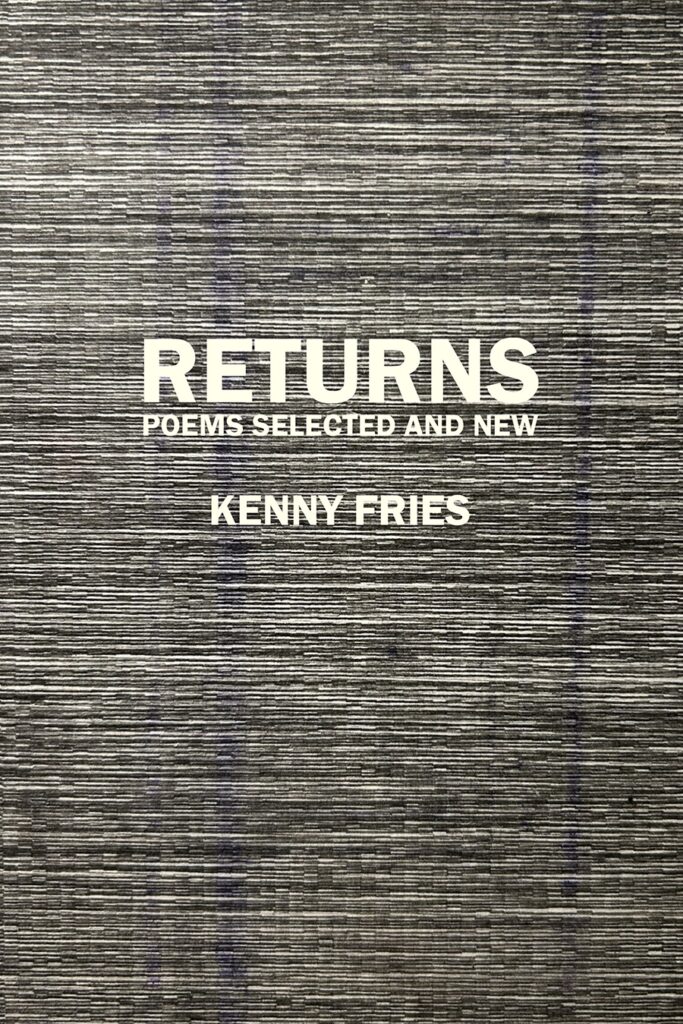
This past July, Propel published Returns: Poems Selected and New, which includes four decades of my poetry, a significant marker in my writing career. Bringing together poems from hard to find, mostly out of print books, Propel, by publishing Returns, makes my poetry more accessible to both younger and older generations of writers and readers.
Much of disability history is not recorded, or not remembered. So, I wanted to mark an historical event that happened recently, which included two of Propel’s contributing editors, showing how Propel helps foster a cross-generational dialogue and community for disabled poets.
In 2004, in a keynote, “Writing Against Canon, Writing Against Cliché; Creating a Canon, Becoming a Cliché,” given as part of the MFA creative writing program where I taught for 27 years, I write: “I never had a canon. There has never been a canon of literature about people with disabilities. Or, to be more accurate, the accepted canon of what I most wanted to write about was the opposite of the experience of my life.”
Though the Propel Poetry Series doesn’t aim to create such a canon, it does empower disabled poets to view themselves as part of an important, I’d say crucial, poetics, in which the disability experience as subject or subtext, is true to our lives.
Perhaps other books, especially anthologies of disabled writers do create a canon, however diverse, of disability literature. With this in mind I’ve been publicly marking an historical event that recently took place, which included two Propel Contributing Editors, as well as myself. Because the panel wasn’t recorded, I want to make sure there was a track that this important meeting and discussion did take place, and to acknowledge its importance.
On October 16, at the Desert Nights, Rising Stars Writers Conference, hosted by the Virginia G. Piper Center for Creative WritingatArizona State UniversityinTempe, AZ, I was on a panel titled “Disability Futures.” With me on the panelwere fellow disabled writers Travis Chi Wing Lau (Propel Contributing Editor) and Naomi Ortiz. The panel was moderated by Connie Voisine, and in the audience was writer Sheila Black (Propel Contributing Editor), who is the Assistant Director of the Piper Center and lead organizer of the conference.
During the panel discussion, it became apparent an important historical gathering was taking place. Travis, Naomi, Sheila, and I edited groundbreaking anthologies of disabled writers. We were, for the first time, in the same room, in person, talking about editing our anothologies, among other disability and writing related issues.
In 1997, I edited Staring Back: The Disability Experience from the Inside Out, the first multi-genre anthology of US writers with disabilities to be published by a commercial publisher (Plume).
In 2011, Sheila edited (with Jennifer Bartlett and Michael Northen) Beauty is a Verb: The New Disability Poetry (Cinco Punto Press).
In 2026, Travis and Naomi edited (with Camisha Jones and Michael Northen) Every Place on the Map is Disabled: Poems and Essays (Northwestern University Press).
This kind of meeting is rare. And though I hint at the reasons at the start of this post, I could spend many pages writing about why such a meeting doesn’t happen much. But on October 16 it did happen. I hope that we can find ways, and the resources, to have more of these cross-generational discussions about Disability Culture and history.
The Propel Poetry Series, which currently consists of eight books, is a burgeoning part of such dialogue, creating history from which writers and readers—disabled and nondisabled alike— can benefit and learn.