
"A monumental achievement—ambitious in scope, brilliant in execution, and unlike anything currently in Islamic studies. Its comparative reach and genuinely multidisciplinary ethos set a new benchmark for the field."—Syed Akbar Hyder, author of Reliving Karbala: Martyrdom in South Asian Memory
"Rich in archival discovery, fieldwork, and conceptual insight, it is a major contribution to the study of gender, memory, Shiʿi identity, and sacred space in modern Islam."—Hassan Abbas, author of The Prophet’s Heir: The Life of Ali ibn Abi Talib
Description
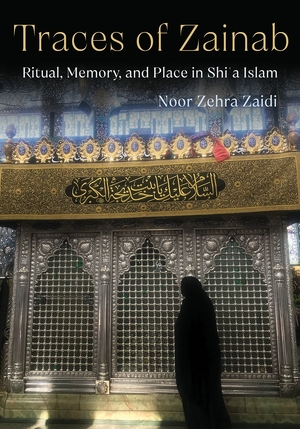
Grief, celebration, and devotion map connections across time and space. linking histories, sites, and believers. In Traces of Zainab, Noor Zehra Zaidi explores the histories—mythic, contentious, and hagiographic—of sacred places that connect believers of Shiʿa Islam. Focusing on Ahl al-Bayt, or the family of Muhammad, and particularly the figure of Zainab, a daughter of ʿAli ibn Abi Talib, Zaidi delineates how communities build and contest these spaces, revealing a rich, sacred geography where ritual and memory intertwine.
Traces of Zainab unites the histories of three different sites: Sayyeda Zainab shrine in Syria, the Bibi Pak Daman shrine in Pakistan, and Al Rashad women’s prison in Iraq. Each site, through dedication to the daughter of ʿAli, becomes a link to the idea of ongoing grief shared by Shiʿa Muslims since the Battle of Karbala, an episode that played a critical role in the split between Shiʿa and Sunni Muslims. Zaidi draws upon municipal, spiritual, and material histories through archival and oral methods to demonstrate how Shiʿa Muslims interact with and renegotiate their understandings of Zainab’s role within Islam. Across an array of religious connections, Zainab has become as much a source of connection and resistance as a site of debate over gender, national identity, sectarianism, bodily autonomy, state control, incarceration, and religious practice.
About the Author
Noor Zehra Zaidi is an assistant professor of history at the University of Maryland, Baltimore County.
Related Interest
Series: Gender, Culture, and Politics in the Middle East
6 x 9, 470 pages, 36 color illustrations, 1 maps
June 2027