

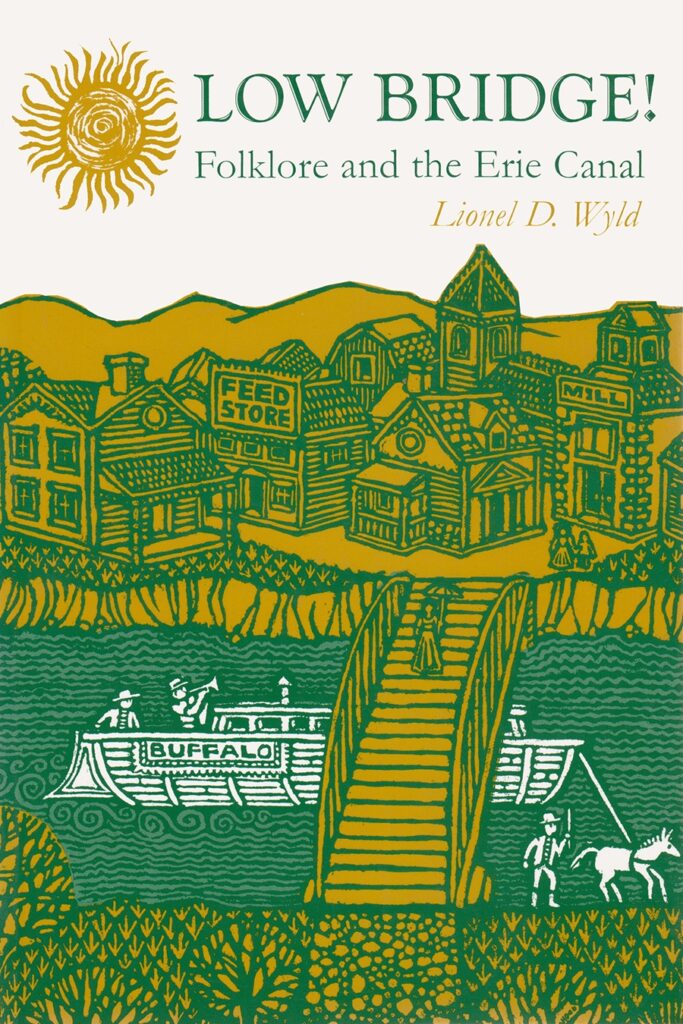
The years following the construction of the Erie Canal saw the publication of a number of novels and books for young readers, serving the new interest in the modern architectural wonder. In Low Bridge! Folklore and the Erie Canal, author Lionel D. Wyld recounts some of the early 20th Century literature and performance that sprung from the canal and canaller culture. Wyld’s book includes many passages directly from journals, letters, and newspapers at the time, and the typographical errors are reproduced here as originally printed.
The Erie Canal has been called “an expression of man’s courage, vision and determination” like all monumental human experiences, it proved to be an influence of no minor importance upon the life, literature, and culture of the people. Its inspiration lay quite obviously in the achievement of men working largely by rule of thumb to build an inland waterway some 360 miles long, and with eighty-two locks and a feeder system properly arranged for, to connect the tide water of Hendrick Hudson’s River with the Great Lake, Erie. At several points solid rock had to be assaulted by blasting crews of “powder monkeys” directed by self-made engineers who were little more experienced in canal-building that those they directed. The Great Cayuga Mash alone provided a story as stirring—and as similar, in climate if not in setting—as that of the Panama Canal almost a century later. And the refusal of help by the Federal Government made the whole Erie project the more remarkable. The Erie Canal was the work of the State and as one write put it, when proud Yorkers used state they meant “the plural noun referring to people, not singular, referring to government.”
It is no small wonder than that the Erie affected folklore and literature, for it was, during a considerable part of the nineteenth century, one of the principal social and economic factors in the daily lives of a great many people. And the canal, of course, affected still others who had no direct experience with it.
The stream of travelers from Europe who visited America during the first half of the nineteenth century found, after 1825, an attraction which had to be seen and experienced. Until the Civil War, when the tourist mania finally abated, foreign travelers came to York State to see the falls at Niagara and Trenton, and, in the earlier period especially, the marvel of the Lockport flight of locks and other feats of engineering which the Erie Canal had to offer. Many of these persons, as have been noted earlier in this book, were literary personages , and actors, actresses, and statesmen — persons who contributed, in diaries, journals, and travel-books, to creating very early a body of Erie Literature.
Native American writers, among them notables like Hawthorne, William Dunlap, Melville, and Howells, found in the Erie something interesting and usable, but their contributions provided quality rather than quantity for the literary history of the canal. Not until Yorker regionalism itself reached out for mature expression did writers see in the canal a fruitful area for exploitation. David Harum began the process; Rome Haul put the capstone on it. For the latter achievement, Edmonds might rightly enough be called “The father of the Erie Novel.” Samuel Hopkins Adams, starting later, proved more sustaining, but Edmonds highly productive Erie years, from Rome Haul (1929) to Chad Hanna (1940), are an enviable record.
The canal’s influence on other areas of literature has been significant too. Juvenile fiction, for obvious reason, found the Erie Story useful; and non-fiction juveniles like Through the Locks (1954) are perhaps inspired largely by the popularity which the Erie Canal has had with young and adult readers alike. Where the canal figures in other literature, it is usually tangential, contributing to authenticity of setting and mood. Often it rides along, so to speak, as a part of necessary regionalism. A “gang from the Erie canawl” for example, join a veritable multitude of other Yorker characters in viewing the central figure in The Cardiff Giant, a regional play by A. M. Drummond and Robert E. Gard. The canallers (“We’re— the—best—damn—singers—on—the—damn—canal . . .!”) enter chorusing “The E-ri-e.” This drama, subtitled “New York State Show,” and based upon the famous hoax of 1869, catches much of the authentic flavor of the human comedy at work to prove the truth in the statement of P. T. Barnum (who, incidentally, wanted to buy the giant) that “there’s a sucker born every minute.”
The giant and canallers also figure, along with York State’s David Hannum, in The Cardiff Giant Affair, a Clarence Buddington Kelland novel serialized in the Saturday Evening Post early in 1959. Set largely in and near Syracuse, the novel draws upon the showing of the giant as a principal framework for mysterious events to take place. One canal couple, Ma and Zacharias Wheelwright, are both charmingly and authentically drawn, and canawlers run generally through the story.
Canal lore and an interest in regional literature combined to influence the writing of a one-act play, A Dam for Delta, by Thomas F. O’Donnell. The action takes place in April 1905 when the villagers of Delta were faced with eviction by the State when the new dam went through. Capt’n Snyder, described as “a retired—involuntarily retired—canawl captain, a vigorous and peppery old man,” recapitulates the canawler’s experience in New York State: “First we build the Erie, then we build the Black River Canawl, then we build railroads. Now we build a whole lake. Tell you, always somethin’ doin’ around here.”
Drama and the Erie Canal always seem to have gone hand in hand. When Edmonds’ Rome Haul reached Broadway as The Farmer Takes a Wife, national interest in the Erie story was rekindled. When the motion picture version appeared, as Harold Thompson pointed out, the Middle West welcomed it warmly , for there were sons and grandsons of the hardy emigrants who knew firsthand the full worth of the Erie Canal. Through the medium of the novel, Samuel Hopkins Adams’ Banner by the Wayside added further insights into York State’s dramatic history; as already noted, the Thalia “T,” like most touring troupes, rode the canal boats from “port” to “port.” The Erie greatly influenced the dramatic arts aspect of culture in New York State. “The old ‘canal’ literally,” said one writer, “Brought the drama to Schenectady and every other town and hamlet between Albany and Buffalo which could boast of a local ‘opera house’ or even a good sized hall. Travelling troupes of thespians rode the canal packets from village to village pausing to present their dramatic wares to a populace which found romance and release rom the humdrum existence of small town life.” The most important theatrical companies always tried to make Buffalo before the annual freeze-up of the canal, an important factor in Buffalo’s rise to metropolitan statue. (Any town could temporarily become the center of drama if a boatload of actors become froze-in there.) Famous names like Joseph Jefferson and Junius Booth “played the boards” in York State, joining the many other thespians, known and unknown, who travelled the Erie Canal.
The Erie has, of course, been of greater influence on fiction than on any other single genre. For a time it was the subject of intensely patriotic, if not too profound, verse. In the drama its influence, as has been noted, served more to affect culture in the main than to provide inspiration for playwrights. Biographical words include the Erie only insofar as the canal touched the lives of the principals, and no biographies exist of the famed “Erie engineers” whose stories in themselves ought to be romantic and rewarding tasks for the biographer. In the area of children’s literature, the Erie Story has provided a number of creditable juveniles, the vast majority within the last tow decades.
Certain conventions and motifs are noticeable to the critic of Erie fiction. Many of the novels, whether juvenile, or adult, present a version of the “rages-to-riches” theme of “The country boy makes good.” Dar Harrow, Chingo Smith, and others, such as Dr. Horace Amlie in Canal Town, could probably be considered a variation on this theme. Most of these stories involve, perhaps more importantly, the concept of the maturing hero. Emdonds’ Dan Harrow and Jerry Folwer Fall into this category. What might be called the “standard” Erie novels ought to contain a fight—a convention begun by Edmonds in Rome Haul and adopted by Adams, Fitch, and other novelists. A depiction of the “fighting canawler” reflects and times and adds to the authenticity of the novel’s setting; a fight scene between a central character, especially the hero, and the canal bully becomes furthermore a structural literary device, contrived by the author for purposes of plot and tension. When Dan Harrow and Jotham Klore meet in Rome Haul it as much a “showdown” as that occurring in the climax of any western novel. The “runaway befriended” seems to be another tried-and-true convention for the Erie novelist. Thus, Jacob Vandermark, befriended by Captain Sproule (Vandermark’s Folly); Tim Brady, befriended by the Wades (The Ring Buster); and juvenile heroes like David Burns (Along the Erie Towpath) and Chingo Smith (Chingo Smith of the Erie Canal) show the popular appear of the Samaritan approach. Even Obedience (Becky) Webb (Sunrise to Sunset), lured by promises of grand living at a Troy mill, fits into this patter; Guy Roy—the knight-errant, as it were—plays the role of protector through the novel.