
"Hot rods. Rock-and-roll. Race relations. Urban decay. Suburban contentment and strain. Decker’s Kodak Elegy strides the tightrope of 1960s America with passion and skill. His remembered Rochester is tantalizingly rich with character and change."—Alyson Hagy, author of Ghosts of Wyoming: Stories
"Beneath the sheer ordinariness of Decker’s childhood lurks the horror of democracy’s failures: the relentless decline of Eastman Kodak and other industrial giants; the deterioration of America’s urban core; unresolved racial conflict; the unrelenting, yet ignored, violence of a colonial power at home and abroad."—John Carlos Rowe, University of Southern California
"Decker vividly captures a piece of central New York culture, history and geography through the eyes of a sensitive and curious boy-becoming-a man."—David Lloyd, author of Boys: Stories and a Novella
"A testimony to the middle-class citizens of post-WWII suburbia that emphasizes class- and race-consciousness and the individual’s relationship to American political and cultural ideologies —compelling reading."—Sarah Berry, Hobart and William Smith Colleges
"Reminiscent of the film Rebel Without a Cause, as through his own childhood Decker navigates the smoldering national fire beneath the apparent calm and prosperity of American suburbs in the 1950s and early 1960s."—Stephen Haven, author of The River Lock: One Boy’s Life along the Mohawk
Description
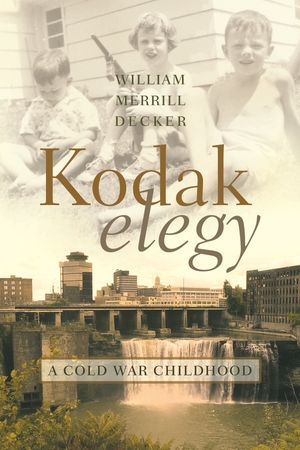
What was it like to grow up as the son of a Kodak engineer during the company’s glory days? Decker presents a vivid portrait of life in the Rochester suburbs where residents eagerly conformed to period expectations: two kids, two cars, a move from a snug middle-class neighborhood to a spacious upper-middle-class subdivision. In recollecting the blithe and troubled scenes of America’s postwar prosperity, Decker evokes a bygone era with rich detail and biting clarity. Depicting the banalities of the place and time, Kodak Elegy narrates a political education shaped by the Civil Rights Movement, John F. Kennedy’s assassination, the Vietnam War, and the constant threat of nuclear exchange. Concerned throughout with the destructive forces masked by American affluence and idealism, Decker closes with a meditation on the 1995 Oklahoma City bombing, a crime perpetrated by a Western New Yorker in the state where the author has long made his home.
Chronicling the late fifties through early seventies, Kodak Elegy delves into the stories of aging relatives and neighborhood life in the old city core. The author traces his family connections with the Hudson Valley’s Dutch settlements and Rochester’s German-American immigrant community, the force behind the area’s horticultural renown. He highlights his family’s ties with Eastman Kodak, the source of Rochester’s twentieth-century wealth and civic pride. In the vein of American Beauty and Revolutionary Road, Decker mines the landscape of his suburban upbringing and uncovers the thwarted dreams of family and friends, recovering in the process his dream of escape as well as his own residual attachment to the utopian vision of the “Kodak Moment.”
About the Author
William Merrill Decker is professor of English at Oklahoma State University. He is the author of Epistolary Practices: Letter Writing in America Before Telecommunications and The Literary Vocation of Henry Adams.
May 2012