
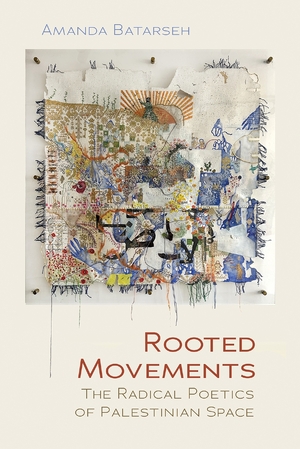
"Among the most outstanding works on Palestinian literature."—Joseph R. Farag, author of Politics and Palestinian Literature in Exile: Gender, Aesthetics and Resistance in the Short Story
"Batarseh offers an original and innovative analysis that will have a profound impact on the way we understand Palestinian society and culture."—Steven Salaita, author of Inter/Nationalism: Decolonizing Native America and Palestine
"Rigorous, reflexive, innovate, and insightful, this work expands how we think of the imperatives of holding ground and remaining mobile, of honoring tradition and embracing innovation, of bridging land and sea, and of imagining futures through, despite, and outside of the devastating and ongoing Nakba and US-Israeli genocide of Palestine."—Sherene Seikaly, author of Men of Capital Scarcity and Economy in Mandate Palestine
"Through deeply erudite readings of Palestinian ethnographic, literary, and theoretical works, and in generative engagement with Arabic, Indigenous, and Black Studies, Rooted Movements compellingly explicates what Batarseh terms 'the radical Palestinian imagination,' a collective practice of liberatory and decolonial thought that addresses each of us—here and now—with an urgency that the ongoing devastations of our time continue to demand."—Jeff Sacks, author of Poeticality: In Refusal of Settler Life
"A masterful dismantling of colonial logics and reductive binaries, Rooted Movements centers Palestinian knowledge production to reimagine a radical, ethical, and liberatory poetics of space—one that reveals movement not as a negation of indigeneity, rootedness, or resistance, but as integral to their realization."—Refqa Abu-Remaileh, author of author of Country of Words: A Transnational Atlas for Palestinian Literature
Description
Present in the heart of modern Palestinian literature is a pervasive sense of rootedness, sustained and nurtured by a deep care for land stewardship and embedded in a spatialized history. In Rooted Movements, Amanda Batarseh examines the epistemology of Palestinian Indigeneity based in a radical relationship to place. Against a colonial logic that often centers displacement as the chief lens through which to understand Palestinian connection to place and spatialized existence, Batarseh argues that Palestinian literature poses Indigeneity as a dialectic relying as much upon rootedness as on ideas of movement.
In elaborating this tension, Batarseh develops a methodology of reading Palestinian literature that foregrounds how Palestinians negotiate space and removal through liberatory mobilization and not as a symptom of zionist, colonial violence. Reading the poetry, creative nonfiction, essays, novels, and films of writers in Palestine and in exile—from Ghassan Kanafani to Naomi Shihab Nye, Hussein Barghouthi, Raja Shehadeh, Ibtisam Azem, and Randa Jarrar—she exposes the limitations of focusing on the geopolitical borders of a modern nation-state and offers alternative imaginaries not bound by colonial spatial control. Instead, the Palestinian poetics of space Batarseh articulates engage rooted movement as an Indigenous expression of deep-seated and enduring connections to place. Palestine, this place, is not static, enclosed by military boundaries, or frozen in time before or after the Nakba, but generative and looking toward a Palestinian future.
About the Author
Amanda Batarseh is an assistant professor of literature at the University of California, San Diego, where her research and teaching focus on Palestinian literature with a broader focus on Arab cultural production in and outside of Arabic, Indigenous studies, and Mediterranean studies.
Series: Middle East Studies Beyond Dominant Paradigms
6 x 9, 528 pages, 6 black and white illustrations, 10 maps
October 2026