

Tyler B. Parker is assistant professor of political science and international affairs at Mercer University and the author of the upcoming Deference and Defiance: Status Seeking in Gulf-United States Politics, to be published in May 2027.
Amid the ongoing United States-Israeli conflict with Iran, millions of observers are learning about the Gulf for the first time. Whether they call it the “Persian Gulf,” the “Arabian Gulf,” or simply “the Gulf,” they are discovering the region’s centrality to global commerce and security. The Gulf is a key conduit of international trade and holds a significant portion of the world’s proven oil reserves. Until February 28, 2026—when the United States (US) launched Operation Epic Fury against Iran and it, in turn, responded with attacks on Gulf Arab infrastructure and international shipping—crude oil and liquefied natural gas had flowed through the Strait of Hormuz relatively unimpeded.
Central to Gulf geopolitics are the decades-old security relationships connecting the six monarchies along the Gulf’s western waters—Bahrain, Kuwait, Oman, Qatar, Saudi Arabia, and the United Arab Emirates (UAE)—with the US. Since the early 1990s, Washington has relied on these six Gulf Cooperation Council (GCC) states for military basing, diplomatic brokerage, and economic benefaction, making them indispensable to the formation and functioning of American foreign policy across the broader Middle East.
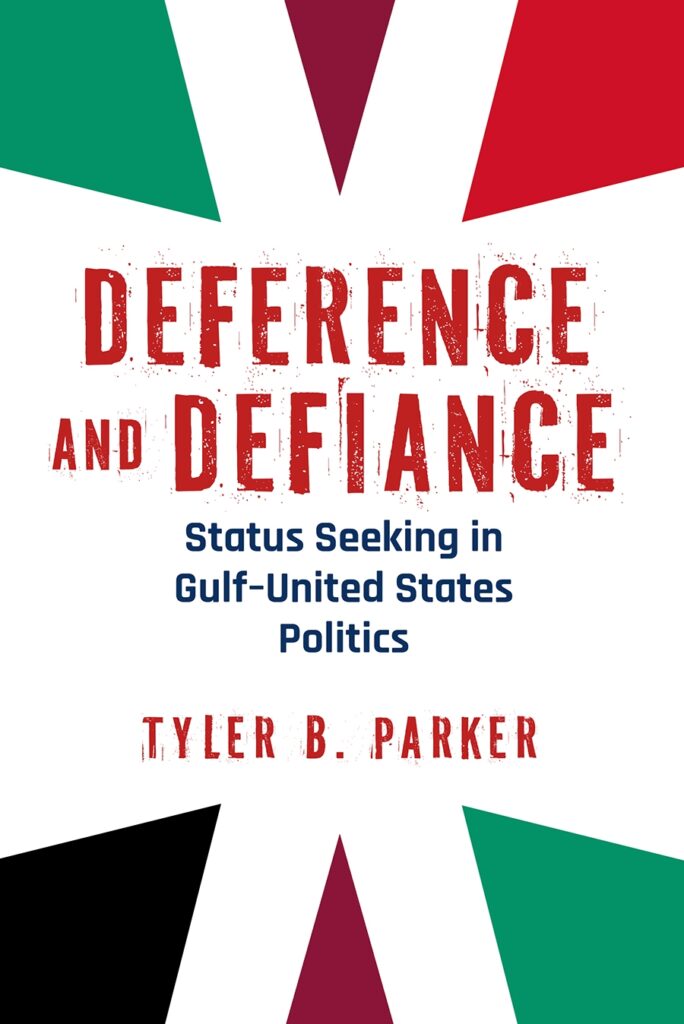
My forthcoming book with Syracuse University Press, Deference and Defiance: Status Seeking in Gulf–United States Politics, asks and answers: Why do America’s Gulf partners support some US foreign policy plans while opposing or avoiding others? More specifically, why do GCC governments choose to support or resist American plans through material and rhetorical means?
Let us consider several puzzling outcomes. Why did all six Gulf monarchies, despite operating within a unipolar international system dominated by the United States, balk at backing Washington’s 1990s policy of Dual Containment toward Iran and Iraq? Why did Kuwait, among the six, provide such extensive diplomatic and material assistance for the 2003 Iraq War? Why did Oman emerge as a critical facilitator of the 2015 Iran nuclear deal? Why did only the UAE and Bahrain join the Abraham Accords and normalize relations with Israel in 2020? And why did Qatar so significantly support the US withdrawal from Afghanistan in August 2021?
Deference and Defiance argues that prestige and status seeking are crucial for understanding GCC support—and non-support—to more than a dozen American initiatives over the past three decades. The Gulf monarchies have treated US foreign policy plans not simply as matters of strategic calculation, but also as opportunities to compete for recognition from their shared American partner. By demonstrating that they are reliable and reputable partners, GCC governments seek status gains that can produce broader social and security benefits.
Yet status seeking is a two-way street. Washington has often overlooked its Gulf partners’ contributions or failed to adequately acknowledge the political and material costs of their support. When recognition is insufficient, GCC states become less willing to support American initiatives from which they perceive little reciprocal benefit and more frustrated with the US. Deference, in other words, is neither automatic nor permanent. And defiance toward American plans can be an important form of agency for GCC states.

Building on foundational Nordic scholarship on small-state status seeking, Deference and Defiance examines how non-allied states with bilateral strategic partnerships with a great power choose to support or resist that power’s foreign policy initiatives. It also examines status competition within the GCC itself—a bloc characterized not only by power asymmetries but also by persistent rivalries among its members. Finally, the book develops a theoretical framework that can be applied to additional asymmetric alliances and partnerships throughout the international system.
Ultimately, Deference and Defiance makes three broad arguments: status matters in international politics, smaller allies and partners compete for status gains, and great powers confer recognition on these states in unequal and inconsistent ways.
These dynamics help explain why the United States is often unable to induce compliance from smaller partners despite profound power asymmetries. They illuminate the autonomy and independence available to GCC states as the international system becomes increasingly multipolar and as the US declines in relative power and prestige. And they offer a framework for examining similar dynamics beyond the Gulf—from East Asia to the North Atlantic and indeed wherever the US’s allies and partners find diminishing returns in their pursuit of recognition as reliable supporters of American strategy.