
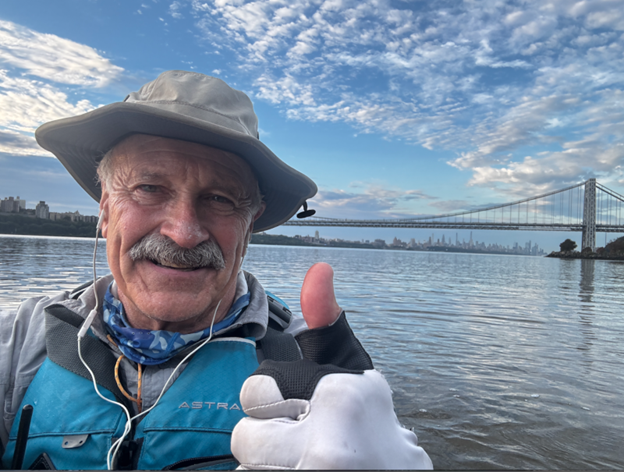
Peter Lourie is the author of River of Mountains: A Canoe Journey Down the Hudson, published by Syracuse University Press in 1995. The memoir tells the story of Lourie’s journey down the river, the first completing the entire passage in a single vessel. This fall, Lourie returned to the river for another journey, which he details in a guest blog post.
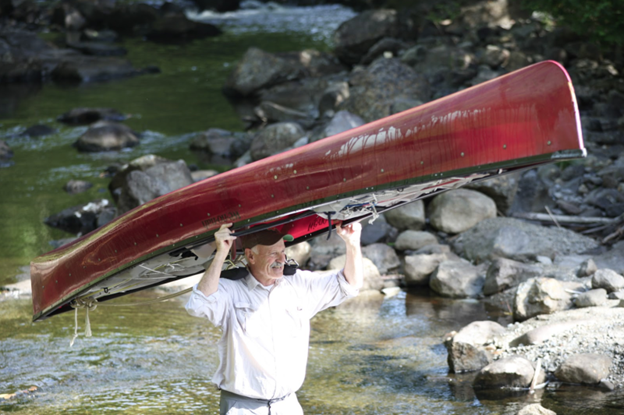
Thirty-five years ago I took a canoe down the entire Hudson River. For three weeks I paddled 315 miles from the river’s source in the Adirondack Mountains to the Battery in Manhattan. Syracuse University Press’ 1995 publication River of Mountains: A Canoe Journey Down the Hudson is the record of that life-altering journey.
Afterwards, I took my canoe, paddles, and camping gear (and slides) into schools to share stories from that journey—I talked about the people along the river’s shore, the beauty of the river, the history and ecology, the longing I felt for family and home, and the hot searing feelings of being on water alone for as many as 12 hours a day.
Fast forward to 2023 on a hike in the Tucson mountains. In a flash of self-discovery, wondering what it would be like to go back to a river to see what had changed in 35 intervening years, I decided to paddle the Hudson a second time. Surrounded by cholla and saguaros I thought the greatest adventure might be to return to my favorite river that had spawned not only River of Mountains but also a novel for kids, The Lost Treasure of Captain Kidd, and a young reader’s 48-page version of the canoe trip, Hudson River: An Adventure from the Mountains to the Sea.
Maybe this time, I’d write a different kind of book, a memoir or a series of profiles and sketches, or both. I didn’t want to repeat myself, or see the same things exactly. So I wondered what could be new in this echo of a journey,
On September 1, 2025, in Middlebury, Vermont, with a loaded pick-up truck, two canoes and a sea kayak on top, I set out for the upper river, a few hours west of home. At 73, I’d sleep in real beds at friends’ houses, Airbbs, forgoing any guerilla camping. I was done with tents. Too stiff. Wherever I’d start paddling in the morning, I’d return there by Uber to fetch the truck and then go pick up my canoe. I’d eat well, sleep well, look for old pals and new. Then start paddling where I had left off the day before.
I planned my trip carefully. I trained daily on nearby Lake Champlain. For two years I began talking to people along the river. I was collecting stories. I had a full folder of interviews before I even left my home. I went out with a state biologist tagging sturgeon, I hopped aboard a tug, and paddled sections to explore in advance.
Then two weeks before departure, in mid August I got Covid. Training sessions went from 8 miles a day down to zero. Ten days later, a few days before leaving, I mustered a mere 2 miles of paddling a day.
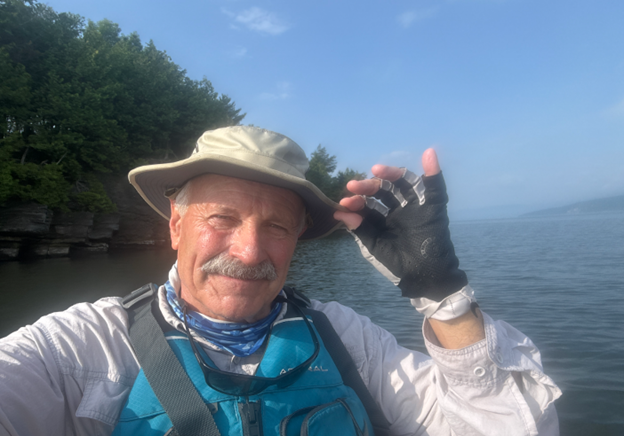
As with the first trip, I knew that working my way downstream I would gain strength daily so that when I reached New York Harbor four weeks later, I’d be strong and confident in big and contrary water.
Leaving this past September was perfect. I lucked out! Every day I was graced with 70-degree autumn sun and gentle winds mostly at my back. The only two days it rained were the days I waited for the final weekend to finish my trip in New York Harbor when the dangerous ferries didn’t run.
September is a dry month for the upper river, and the rapids had all turned to shoals and boulders. It was not a month for running Hudson white water. Besides, on the first Hudson trip I’d already done every inch of whitewater with my pal Ernie LaPrairie. This time I “did” the rapids on a rail bike towing my canoe behind.
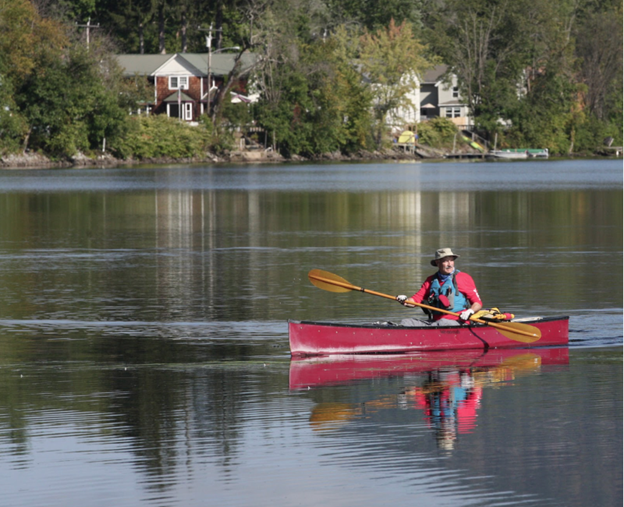
When the river became navigable just south of Warrensburg, I launched my 35-lb Kevlar solo canoe at Stony Creek and paddled the rest of the way to the city, switching to my sea kayak in Nyack to handle the big waves of the lower estuary.
On Sept 28 I reached the mountains of glass and steel, Ellis Island and the Statue of Liberty. When I saw the Verrazano Bridge, I wanted to keep going out to sea, never to end this river travel. River time is space away from the news, politics, and confusion. River time is back-to-basics, timeless travel, an antidote to the digital world.
I followed the western shore on my new path with the setting sun over my shoulder. I looked east toward the path of my youth which had been down the shore of Manhattan. The perspective had changed totally.
Traveling a great river a second time might be the best adventure of my life. I met old and new friends, I learned a ton of new stuff, and I found the river in so much better shape than three decades before.
I’ll be working on the material when I get to Tucson in January. Perhaps it will become another book, but it doesn’t really matter if there’s no book.
A few days after my trip, someone asked me if I achieved what I set out to do. Was it as good a trip as I had hoped? In some ways no, first love is always the freshest, most powerful, memorable and magical. But this second time round I kind of knew what was where and how to plan such a trip, so there were different layers of joy, like reading a great book a second time.
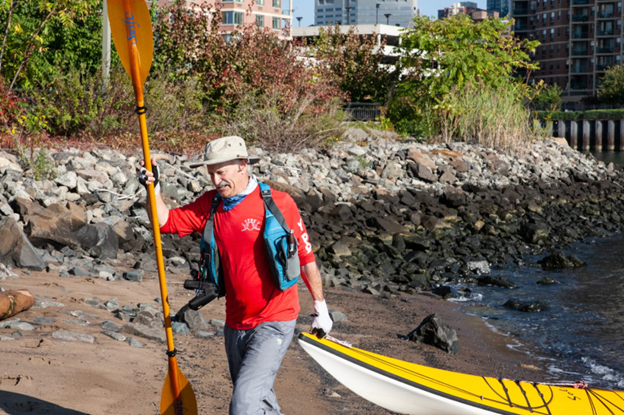
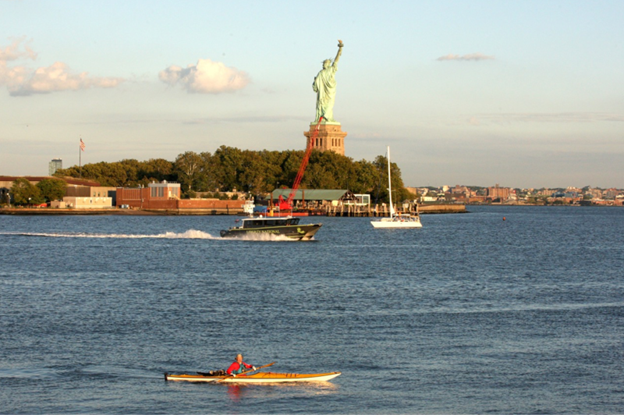
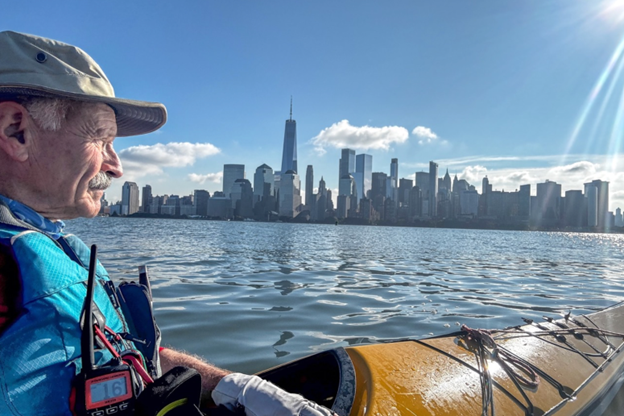
Back in 1990, without a cell phone, I slept in tents and lived a river life more than this repeat trip with a truck and Uber and Airbnb. Although I hardly used my cell phone, I looked at apps on tides and currents, weather and air quality. And I kept a journal on my phone’s Notes app.
If I were to measure this trip against the old one in terms of the people I’ve met, I’d say the level of satisfaction now is deeper. Although the paddling is always a solo experience, the people who knit the river together are what makes a river special. The deepest joy for me has always been companionship, unexpected encounters–the way an older man cherishes friendships and family and strangers while the young man often races past them without a glance….
Copyright 2025 by Peter Lourie. All rights reserved. For use by Syracuse University Press with permission.