
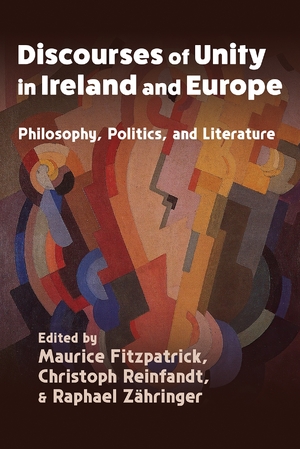
"The collection stands as a valuable and much welcomed approach to the topic of unity, which deserves further study nowadays on an international scale."—Auxiliadora Pérez Vides, author of Only Them: Family and Feminism in the Contemporary Irish Novel
"Discussing Irish unity at this time is not only desirable but necessary. For decades, the topic was deemed to be both unrealistic and subversive of peace and order on the island."—Liam O'Dowd, coeditor of Religion, Violence and Cities
Description
The binary between a united Ireland and the current form of partition has provoked writers and scholars and established an important debate about what unity would look like. Discourses of Unity in Ireland and Europe charts and critically discusses the challenges of articulating unity while one-sided discourses—on either nationalist or unionist grounds—have gradually been integrating an Irish identity that finds itself between Britain and Europe.
Crucial to all of this is the role of writers in reimagining Irish writing before and after the Northern Ireland peace process and in reconstituting an idea of Irish unity in their works. Maurice Fitzpatrick, Christoph Reinfandt, and Raphael Zähringer bring together scholars from the fields of philosophy, political science, diplomacy, history, and literary and cultural studies to interpret how the concept of unity has manifested in literary, historical, and political texts. This wide-ranging approach considers a variety of economic perspectives, including how generations of economic shifts have impacted the image of Ireland’s relationship with the UK and Europe.
Ultimately, Discourses of Unity in Ireland and Europe provides coordinates for current debates about how to prepare for Irish unity and what shape it should or could take.
Table of Contents
Introduction
Maurice Fitzpatrick, Christoph Reinfandt, and Raphael Zähringer
Part One. Philosophy and the Public Sphere
1. Unity beyond Sovereignty: Some Philosophical Reflections from an Irish Perspective
Richard Kearney
2. Anarcho-Cosmopolitan Imaginings of a Future Ireland and Europe? The 1980s Public Intellectual Writings of Richard Kearney and a Europe of Regions
Fergal Lenehan
Part Two. Politics and the Public Sphere
3. Toward Irish Unity
David Donoghue
4. Reconstructing the Good Friday Agreement on Social Media: Discourses of Unity and (Dis-)Alignment
Patricia Ronan
5. Partition Revisited: On National Literatures and Reunification in the Late Capitalist and “Post-Literary” Era
Joe Cleary
Part Three. Literature and the Public Sphere
6. Working Models of Wholeness: Writers and the Peace Process
Marilynn Richtarik
7. A Memorial to Hospitality: The Formal Challenge of Cherry Smith’s Poetic Sequence Famished on the Great Hunger
Jessica Bundschuh
8. Between Unity and Dispersion: Irish and English Drama in Times of Brexit
Michał Lachman
9. The Fractured Unity of the Nuclear Family: John McGahern’s Amongst Women
Ralf Haekel
10. Family Fragments: Discourses of (Dis-)Unity in Anne Enright’s The Green Road
Carolin Steinke
11. Haunted Terrain: Narrative Representations of Trauma in Post-Agreement Northern Ireland
Galyna Hartischyn
12. Writing Home: Ethnic Minorities in Ireland, the Negotiation of Borders, and the Idea of Irish Unity in the Works of the “New Irish” Poets
Gerold Sedlmayr
13. Strange Encounters? Narratives of (Comm)Unity and Frames of Perception in Melatu Uche Okorie’s “Under the Awning”
Alessandra Boller
List of Contributors
Index
About the Author
Maurice Fitzpatrick is a lecturer, film director, author, and visiting scholar at the University of Notre Dame. He is the author of The Boys of St. Columb’s and John Hume in America: From Derry to DC.
Christoph Reinfandt is professor of English literatures and cultures at the University of Tübingen. He is the author of Englische Romantik: Eine Einführung and Romantic Communication: On the Continuity of Romanticism in Modern Culture.
Raphael Zähringer is a postdoctoral researcher at the University of Tübingen. He is the author of Hidden Topographies: Traces of Urban Reality in Dystopian Fiction.
August 2026