
"This is a wonderfully comprehensive theoretical analysis of international negotiation synthesizing major approaches. . . . The authors also include excellent accounts of a wide variety of cases of international peace negotiations, explaining the successes and the failures in terms of the theoretical ideas and research results examined in the book."—Louis Kriesberg, author of Fighting Better: Constructive Conflicts in America
"This book is an invaluable resource for understanding the scope and limitations of any peace process. It is a crucial tool for problem-solving and transforming the relationship between former enemies. In today’s challenging times, this analysis is a must-read for students, scholars, and practitioners who want to view and shape global negotiations as a win-win endeavor."—Valerie Rosoux, Professor & Director of Research, FNRS - University of Louvain
"The authors ambitiously offer a rich variety of negotiation cases to illuminate various schools of negotiation theory. The result is a fine blend of history and negotiation analysis, and each dimension enriches the other."—Anthony Wanis-St. John, Associate Professor, American University
"Hopmann and Vukovich build on foundational knowledge, starting with simple models and proceeding gradually to increasingly complex understandings of negotiation processes and contexts. dealing with real-world problems. Not to be missed by students of negotiation and mediation, this book is a model for the practical application of scholarship relevant to many fields. Congratulations to the authors for this very significant contribution."—Daniel Druckman, Schar School of Policy and Government, George Mason University
Description
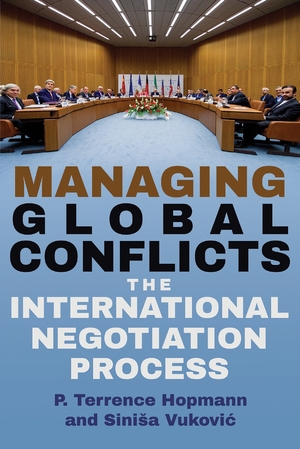
Managing Global Conflicts presents an overview of major alternative approaches to the analysis of international negotiations developed in the literature of the past sixty years. By combining empirical verification of hypotheses and a broad interest in what can be learned from existing research, P. Terrence Hopmann and Sinisa Vuković suggest prescriptions for improving the negotiation process to produce better, mutually beneficial outcomes.
The authors examine the extensive tradition of theory and research on international negotiation processes at both the intra-state and inter-state levels. They analyze alternative theoretical approaches and the conditions under which these theories may prove most relevant. By introducing elements of complexity at multiple levels, they explore the factors under which different outcomes may emerge from negotiations in conflict scenarios, including relative power, decision-making structures, the roles of individual cognitive frames, images, and cultural practices.
Hopmann and Vuković present a menu of options for evaluating the relationships between the initial conditions of conflict, the negotiation process, and the outcomes of that process in determining the extent to which conflicts are resolved. Featuring case studies and a thorough analysis of the field, Managing Global Conflicts is an essential resource for students, scholars, and practitioners of negotiation at many levels.
Table of Contents
Introduction: Negotiation in the Management of Global Conflicts
1. Negotiation as Bargaining: Transactional Approaches
2. Negotiation as Problem Solving: Search for Shared Benefit
3. Negotiation in Conflict Management: Stages of Escalation and Conflict Resolution
4. The Impact of Power and Influence: Symmetry and Asymmetry
5. The Multilevel Game: Principals and Agents
6. Human Factors in Negotiation: Individuals, Cultures, and Communication
7. Negotiation Dynamics: Managing the Negotiation Process
8. Multilateral Negotiations: The Search for Consensus
9. Mediation: Third-Party Roles
10. Evaluating Negotiation Outcomes: Efficiency, Fairness, and Durability
11. From Theory to Practice: Improving Global Negotiations
Notes
Index
About the Author
P. Terrence Hopmann is a senior fellow at the Foreign Policy Institute and Johns Hopkins School of Advanced International Studies. He is coauthor of Unity and Disintegration in International Alliances: Comparative Studies, coeditor of Rethinking the Nuclear Weapons Dilemma in Europe, and author of The Negotiation Process and the Resolution of International Conflicts.
Sinisa Vuković is director of the global policy MA program at the Johns Hopkins School of Advanced International Studies. He is the author of International Multiparty Mediation and Conflict Management: Challenges of Cooperation and Coordination and coauthor of Rethinking Conflict Management and Resolution.
Related Interest
June 2026