
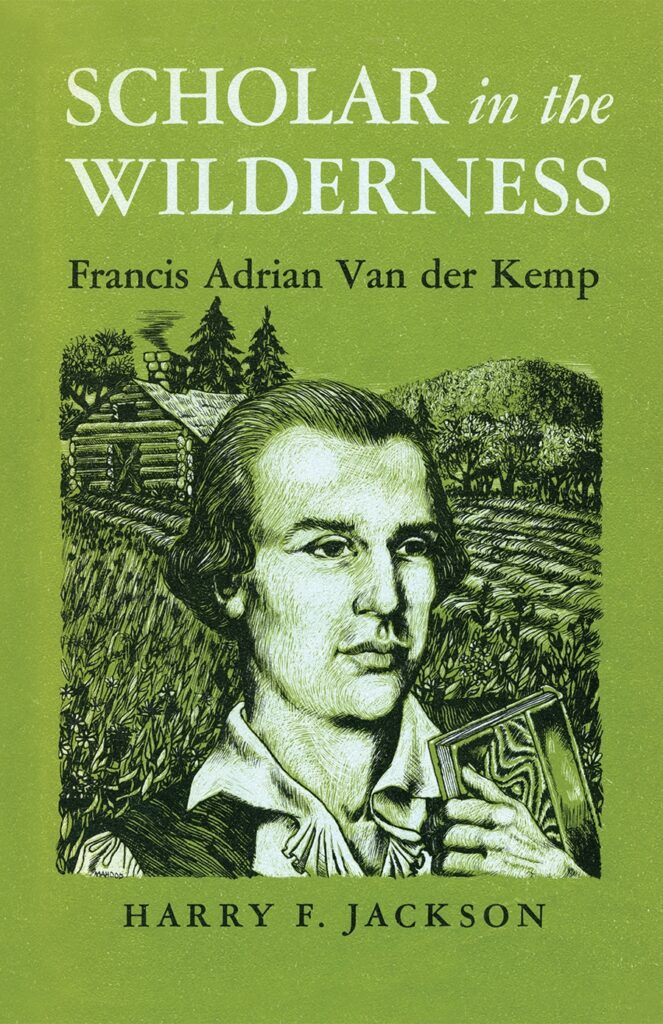
Francis Adrian Van der Kemp was a writer, minister, and political leader of some prominence in Holland when he fled, fearing political and religious prosecution, to Oneida County in Upstate New York. There, through his enquiring mind and prodigious letter writing, he came into contact with many of the movers and shakers of late 18th Century and early 19th Century New York, corresponding with would be presidents, generals, and legislators alike. In a selection from Scholar in the Wilderness: Francis Adrian Van der Kemp, author Harry F. Jackson details Van der Kemp’s efforts to whip local support for the Erie Canal, starting in 1810, spotlighting his personal connection with the would-be governor De Witt Clinton.
Early in 1810 Jonas Platt, one of Van Der Kemp’s closest friends began an active interest in a canal. Through his efforts and for political reasons Clinton’s aid was enlisted. Clinton was a member of the legislative committee setup to examine the possibilities for a canal. The committeemen traveled through the probable areas of location and made a favorable report in 1811. Platt presented a resolution, which was passed by the Senate, to print five thousand copies. Congress considered the canal in 1812 but let it die in committee. The political situation in New York State, with Clinton running for the presidency, and the onset of the war, caused the canal commissioners to withhold a report in 1812. With so little accomplished Van der Kemp still praised Clinton for “so boldly” planning to “enrich New York State with a Magnificent canal-navigation.”
During the war nothing was done except that the legislature repealed the commission’s powers. After the war Platt and others organized a mass meeting in New York City for December 30, 1815, with William Bayard in the chair. Platt was the main speaker and called for action. A committee of four, including Clinton, was set up to draft a memorial to the legislature and a persuasive document resulted. Newspapers noted the meeting and the memorial.
When Van Der Kemp sent his manuscript of the tour to Lake Ontario to Clinton on January 8, 1816, he wrote:
Well shall I have been rewarded . . . if it could spur de Witt Clinton, to use his powerful influence with his friends next Legislature—to have an act passed—to open a canal between Lac Erie and the Mohawk—or to incorporate a company for the purpose. New-York can do it—Amsterdam built its Magnificent State bourse under less favorable circumstances.
In a postscript Van der Kemp added,
I can scarce express the pleasure I felt in seeing a notice of the New York meeting so my wishes have been anticipated—God prosper it—be it thro your influence and unrelenting activity! and posterity will bless the name of de Witt Clinton—No New-Yorker ought to wish to obtain it from the fed. government—it would claim the benefit— and exact the profits.
The next day Van der Kemp wrote to John Adams, “I am stirring again every man’s soul with whom I have some connection to rise in their strength in behalf of our Western Canals.” Whether the word again meant he had supported the action of 1810 and 1811 or perhaps only that he was in general favor dating back to 1792 is in doubt. The rest of the statement shows that he took an active part in the local movement and perhaps by correspondence, with other parts of the state.
The Federalist Newspaper of Utica, Patriot and Patrol, reported the New York meeting favorably on January 12. Beginning in the January 19 issue the paper printed the complete memorial in three instalments. On February 1 a group of interested citizens met in Bagg’s Hotel, Utica and approved the canal project through a petition to the legislature. Other communities in the state did likewise.
The state legislature received a flood of petition and memorials for the the canal and found it impossible to ignore the sentiment. However, some of the leaders were dubious of the scheme and fearful of the political developments that would favor Clinton. After much wrangling of a new commission was approved on April 17 with a $20,000 operation account but with little power. De Witt Clinton was one of the five commissioners. Van der Kemp assured the commissioner that the canal was certain of success. Clinton sent to his admirer a copy of the New York memorial.
The commissioners were busy the rest of the year directing surveys, making estimates, determining locations, and considering financing. They traveled along the route, inspected, conferred and made speeches. Clinton came through Utica from the west in August and discussed the project with the editor of the Patriot. Clinton’s optimism inspired the editor to write an enthusiastic report that the construction was practical and without undue difficult. The story was repeated in other papers.
Van der Kemp was pleased with the article. Yet he realized the financing might be difficult and politics might interfere. He wrote to Clinton in October that the practicality was “above doubt” and he hoped the project would meet no further “pusillanimous obstructions.” Van der Kemp opposed putting a special tax on the areas adjacent to the canal and thought it was bad politics. He believed a loan could easily be obtained in London or Amsterdam if the state guaranteed it. A small general tax could pay the interest and tolls would pay the principal.
Van der Kemp was even more uneasy in December. In addition to favoring the alliance between Clinton and Ambrose Spencer, he went so far as to recommend political plums to ease the opposition.
Your great project stands in my opinion on an unmovable basis—but I know what powerful engines can be set at work by malice and self-interest—It might answer a good purpose—if in the detailed report was proposed the appointment of a committee of four—one from each district—with a competent salary—to superintend the construction of the canal—till it was finished—This might be the means to stop the mouth cerberus—never minding to what party he belonged—provided he was an influential dog and I need not tell you—that few can withstand this magic spell—and I would not scruple to make use of this enchantment—when a grand praiseworthy object might have failed without it.
This was probably the lowest that Van der Kemp ever stooped in his moral principles. The question of expediency for a great undertaking seems to have been uppermost in his mind. He urged again a loan as the basis of financing and emphasized the great destiny of New York State through the canal.