

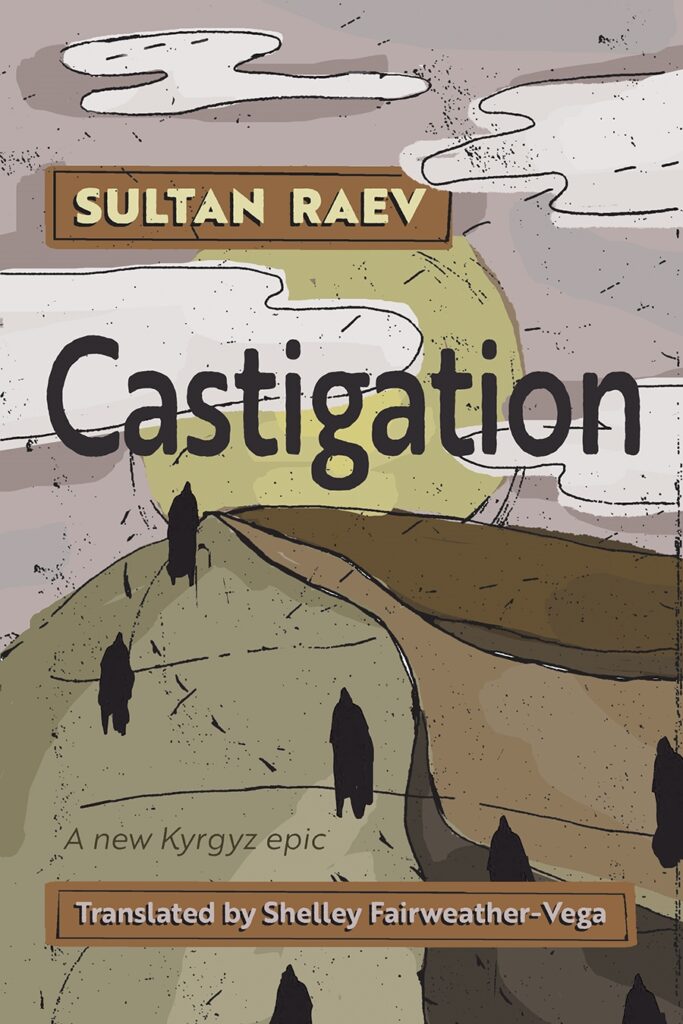
The winner of Kazakhstan’s 2014 Novel of the Year, Castigation is a stunning meditation on humanity’s capacity for both destruction and transcendence. The novel, translated from Kyrgz, tells the metaphorical story of a group of escaped mental patients, journeying across a seemingly endless desert. In the below excerpt, translator Shelley Fairweather-Vega examines the text, author Sultan Raev’s work, and her efforts to preserve what makes this award-winning novel so unique.
By now, you will have realized that Castigation is not, in fact, a biblical tale or a morality play, and it is not an adventure story or a love story, though it is partly all of those things. Nor is it pure historical fantasy, despite all the historical characters (or fictional characters named for them). And even though the interplay between various deities and human souls plays an extremely significant role here, the book is not exactly a religious tract, either.
As someone who has taken this book apart and put it together again in the process of translation, my advice is to give up all attempts to fit this tale into any frame you’ve previously encountered. Unless, of course, you’ve encountered other post-Soviet apocalyptic romantic religious allegories positing a postmodern critique of politics and mental health and righteous condemnation of the excesses of Genghis Khan and Alexander the Great, because this book is one of those.
Author Sultan Raev began his career in the Soviet Union, where creative writing was as centrally regulated as any other public endeavor. This book, however, reaches into Central Asia’s distant past (including the eras of warring Mongolians and Macedonians) for many of its religious, cultural, and historical references. And it was written and originally read in independent Kyrgyzstan, a state we can justifiably say was created and then abandoned by the Soviet Union. Castigation can be read as the author’s response to being suddenly set adrift, newly untethered from all certainty, and left to wander with other former inmates, all as a result of processes none of them can fully comprehend. What sort of leaders emerge in such a situation? Who can be trusted? Where are any of them going? How many snakes will there be, and what does God think of it all? This is one of the rare novels from the region to try grappling with these questions.
A few Soviet relics that figure in the plot require a brief explanation. King Lear’s lines are from the most famous Russian translation of Shakespeare’s play during the Soviet era, the version by Boris Pasternak. I have translated those lines back into English in a way that is not quite Shakespeare, to respect the differences that came with Pasternak’s version. A more despicable aspect of the Soviet legacy in Castigation is punitive psychiatric treatment, notably with sulfosin, a painful concoction of sulfur and oil that remained common in Soviet psychiatry long after its use was banned elsewhere. A thorough history of the drug can be found in M. Marco Igual, “Sulfosin: A Centennial Drug between Therapy and Punishment,” Neurosciences and History 9, no. 2 (2021): 55–68. To stress the drug’s Soviet associations, I chose to use a transliteration of its Russian name: sulfozin.
This translation is the result of some textual triangulation. Raev provided me with an anonymous, unpublished Russian translation of his novel, as well as his own Kyrgyz original. Because Russian is the non-English language I know the best, and I have rarely worked with Kyrgyz, my first instinct was to use the Russian translation as my primary source. But obeying that instinct would have been lazy and also counterproductive. Kyrgyz strongly resembles two languages I can read well (Kazakh and Uzbek), so I found I was able to navigate through the original without problems. That was fortunate, because I quickly discovered that the Russian text was not entirely reliable. For one thing, it tended to either smooth over or ignore many specifically Kyrgyz images and cultural references, applying a domesticating approach. Translating the Russian versions of those passages would have been tantamount to Russifying this book for English-language readers. It also contained some objective errors I would not have liked to replicate in English. To avoid those pitfalls, I realized I would need to pay equal attention to both versions as I translated. I have done my best.