
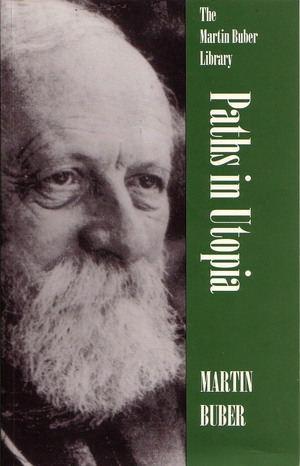
"A summary and scholarly study of humanity's search for the perfect social structure."—Christian Science Monitor
"Buber is a distinguished Hebrew scholar who believes he has discovered the millennium in the agricultural communes of Israel. Distrustful of 'systems,' particularly the Marxian, he looks to the anarchists Proudhon, Kropotkin and Gustav Landauer, but selects only the part of their doctrines appropriate to his case. . . . Highly mystical, he illustrates too well the ease with which sensitive but not overinformed men espouse simple patterns based on the historical truths which they alone can see."—New Republic
Description
In Paths in Utopia, Martin Buber offers a penetrating inquiry into the philosophical and historical foundations of communal life. Engaging critically with both socialist theory and the failures of authoritarian collectivism, Buber traces alternative traditions of cooperative living that emphasize dialogue, reciprocity, and ethical relation. His analysis of the kibbutz as a living experiment in voluntary community provides a concrete counterpoint to abstract utopian schemes, illustrating how shared purpose can emerge from genuine human encounter rather than imposed structure.
Blending social critique with political philosophy, this influential work remains essential for scholars interested in communal movements, democratic theory, and Buber’s broader relational thought.
About the Author
Martin Buber has gained worldwide acclaim for his translations and expositions of various mythic and mystical traditions. His works include On the Bible: Eighteen Studies, Two Types of Faith, and Israel and the World: Essays in a Time of Crisis.
November 1996