
"Broadcasting magazine has always been there to cover the industry it is named after. It has chronicled the explosive growth of an industry that changed the world more than any of us, except perhaps Sol, could foresee. The man we are honoring tonight has covered this revolution—nearly from the beginning. . . . For those of us in the business, Broadcasting was our professional book and Bible."—President Ronald Reagan, former sportscaster at WHO-Des Moines
"[Sol Taishoff] wasn’t just someone who was a casual observer or casual participant in the broadcast industry. . . . His influence and his voice were heard all throughout the industry for a good fifty years, from the thirties until his death in the 1980s."—Michael Henry, Mass Media & Culture Coordinator, Special Collections and University Archives, University of Maryland Libraries
Description
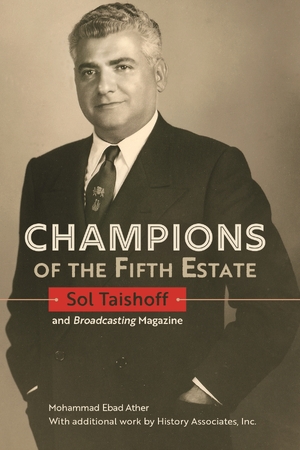
Sol Taishoff was one of the biggest names in twentieth-century radio and television. Yet he wasn’t an on-screen or on-mic personality. A reporter first and foremost and an editor and publisher for most of his career, he was one of a small group of visionaries in the 1920s who grasped the potential of a disruptive new technology: radio. Knowing the emerging industry needed a way to communicate to its members and the wider world, in 1931 he cofounded what would become its most influential trade magazine, Broadcasting.
Taishoff and his staff covered everything from the nuts and bolts of operating a radio station to major news events and especially the growth of federal regulation. When television began to challenge radio in the 1940s and 1950s, he and the magazine expanded their coverage to this new form of broadcasting. As the champion of what he and others termed “the Fifth Estate,” Sol Taishoff and his magazine told the story of an industry that transformed American culture and politics in the twentieth century.
About the Author
Sol Taishoff (1904-1982) was a pioneering radio journalist who cofounded the industry's trade journal, Broadcasting, in 1931 and served as its editor for some fifty years. Born in Minsk to a Jewish family that migrated to the United States when he was a child, Taishoff went to work as a copy boy for the Associated Press in his teens. As a young journalist, he recognized the potential of the new medium of radio and became one of its great champions.
Mohammad Ebad Ather is assistant director of the International Relations Undergraduate Program in the Maxwell School of Citizenship and Public Affairs at Syracuse University, and a PhD candidate in US history at the same institution.

November 2026