
"Parker’s work could not be more timely. As Gulf states assume more assertive roles on the global stage and the future of US security commitments grows less certain, this book is essential reading for scholars, students, policymakers, and anyone seeking to understand the evolving dynamics of US-Gulf relations."—Courtney Freer, coauthor of Tribalism and Political Power in the Gulf
"Deference and Defiance adds nuance and depth to the analysis of US relations with Kuwait, Qatar, and the United Arab Emirates. Parker’s judicious study of critical junctures in Gulf–US ties since the Gulf War enables him to identify significant variations in policy formulation and outcomes that offer great value to scholars and practitioners alike."—Kristian Coates Ulrichsen, author of Centers of Power in the Arab Gulf States
Description
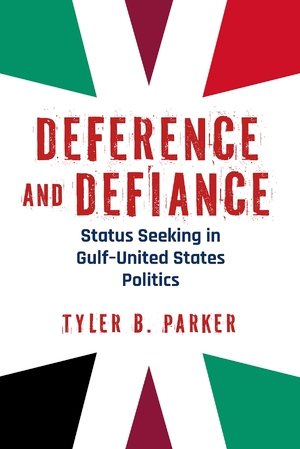
Why do the Gulf Cooperation Council monarchies so often lend their support to American foreign policy—and why do they sometimes push back? In Deference and Defiance, Tyler B. Parker offers a compelling answer rooted in the politics of prestige. For over three decades, Bahrain, Kuwait, Oman, Qatar, Saudi Arabia, and the United Arab Emirates have competitively supplied material assistance and rhetorical backing to US policies across the Middle East. Yet their loyalty is not guaranteed. Parker finds that Gulf states seek recognition as reliable partners, and that Washington’s willingness to grant or withhold that status determines whether they remain deferential allies or become defiant opponents.
Unpacking the intricate dynamics determining how governments approach the United States and one another, Parker traces the status-seeking competition among Qatar, the UAE, and Kuwait across more than a dozen American policy initiatives since the 1990s. The book advances a theoretical framework of four status-seeking strategies—proactive prestige, reactive pursuit, passive observance, and defiant resistance—to explain when and why the Gulf monarchies support or oppose US aims. As persistent conflict between Israel, the US, and Iran shapes the Gulf states’ sense of security, Deference and Defiance exposes the fault lines beneath apparent US influence over the GCC and poses how these states will form and foster diversified partnerships in an increasingly multipolar world.
About the Author
Tyler B. Parker is assistant professor of political science and international affairs at Mercer University.
Related Interest
May 2027